


Fyresdal bygdemuseum and Folkestadbyen in Fyresdal - what to see in Fyresdal?

Fyresdal municipality is a small municipality in Øvre Telemark. Most of the municipality is in mountainous areas, but the village center Fyresdal is located at the northern end of Fyresvatn - Norway's 22nd largest lake. The village has a campsite, a village museum, protected giant pines, the trade, and craft center Folkestadbyen, Hamaren activity park and Fyresdal Tretoppveg. This post describes the village museum and Folkestadbyen.

Fyresdal bygdemuseum (Village Museum) is one of Norway's oldest village museums. It was established in 1909 and is in a small park called Øyskogen in the middle of Fyresdal city center. Since Øyskogen has many burial mounds from the Late Iron Age - 400-600 AD - it has been perceived as sacred ground. This small park has several buildings and objects from the Middle Ages that document Fyresdal's past. Here you will also find a dozen protected giant pines. The museum building is open from 11-16.30 Tuesday to Sunday from 1 June to 15 August. During the rest of the year, groups can book a tour. The open-air museum with the buildings is open all the time.

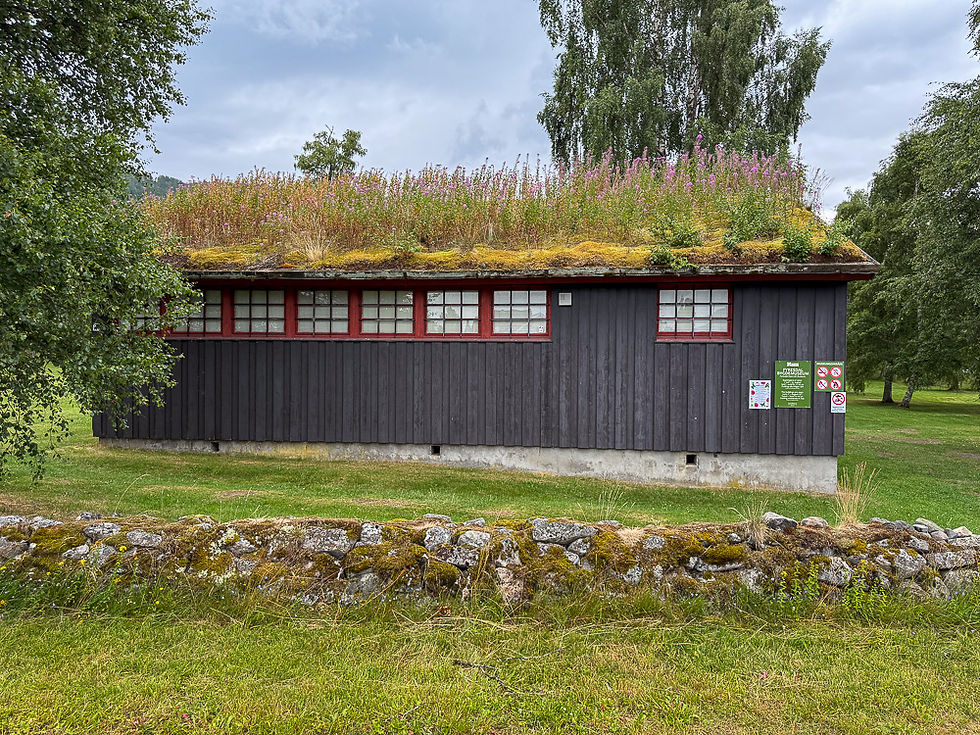


Right next to the village museum is Folkestadbyen. It is a small commercial and industrial center that was formed in the second half of the 19th century when people left the farms to find paid work in forestry or trade. They settled around the Handelslaget on the site of the old Folkestad farm. Some of them moved their old houses to the city, others built new houses, often in the Swiss style.
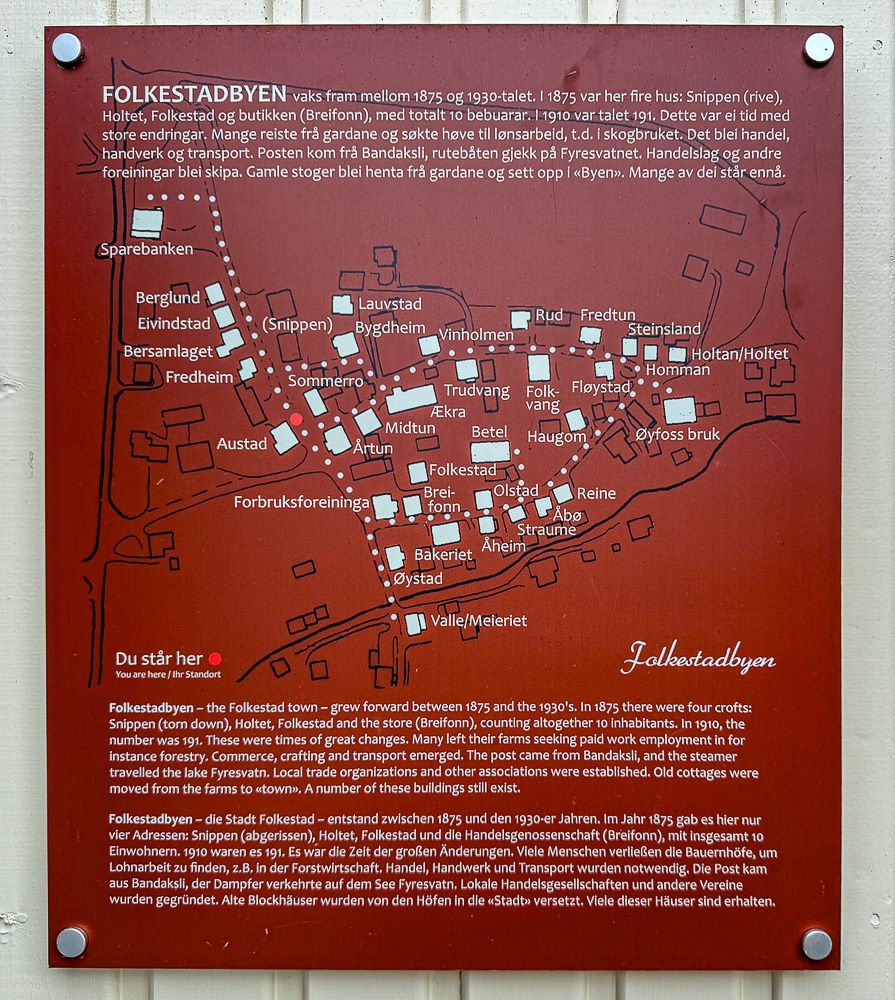
Handelslaget (The trading cooperative) was a link between the boat traffic on Fyresdalsvannet and the old main road that connected the farms along Fyresvatn to the mining village of Bandaksli. By settling here, people had more opportunities to find work. The small town had three streets organized in a triangular pattern: Hovedveien, Skippergata and Lensmannsgata. Here lived craftsmen of various kinds, the sheriff, midwife, postman, traders, and the captain of the ferry on Fyresdalsvatnet.

In this small town 60 years ago, there were five grocery stores, a factory, a dairy, a bakery, a chapel, and an inn. Today, several of the stores have been merged, some of the houses have become museums, and some have been converted into ordinary residential buildings. But there are still guesthouses, chapels, cafes, a bank, and shops. Plaques have been put up on the houses that tell what they have been used for and who has lived there. By walking around the small town, you can therefore get a picture of what life was like here when this was the center of Fyresdal.


The sights in Fyresdal are only a few hundred meters apart. When coming from the north, Hamaren activity park with Tretoppvegen (read more at the bottom of the article) is on the right side of the road, while Fyresdal village museum, Øyskogen and Folkestadbyen are on the left. On the south side between Hamaren and Folkestadbyen, there is a nice sandy beach, a campsite and Moland church which are also worth a visit.


Today's version of Moland Church was built in 1843, but there has been a church building on this site since 1342 when the church was moved to the Moland rectory where the priest Torgaut lived. The name Moland or Morland comes from the word "mor" which means sand or gravel plain, and the Morland priestly family who were connected to the church for many generations took their name from the place. Moland was also the name of the center of Fyresdal until 1879 when Fyresdal was established as a formannskapsdistricht, later a municipality.


In Fyresdal you can paddle on Fyresvatn, one of Norway's deepest lakes, go on mountain hikes, play in Hamaren activity park, or walk Norway's first Fjelltoppveg where you can enjoy the view of Vikefjell and Fyresvatn. People in Fyresdal have traditionally made a living from agriculture, forestry, trade, and power generation. Gradually, tourism has become more important.
More excursions: www.turideer.com
The excursion of the week: Fyresdal bygdemuseum and Folkestadbyen in Fyresdal
Suitable for: Everyone. Strollers and wheelchairs can be used.
Getting there: Enter "Parkering Hamaren Activity Park" in Google Maps. This will take you to a parking lot within easy reach of all attractions in Fyresdal.


Comments