


The 13 best beaches in Villajoyosa - coastal hike - beach life

Villajoyosa is both a municipality with a coastline of 15 kilometers of cliffs, bays and beaches - and an idyllic, colorful coastal town with a long fishing tradition. The town is located 3.2 km northeast of Alicante. It is possible to go hiking along the coast in large parts of the municipality. Along the coastline there are 13 beaches and some bays suitable for swimming. These are described in this article.

The beaches in Villajoyosa vary in length and character from the 1.3-kilometer-long sandy beach at Villajoyosa town with a lifeguard and all the facilities - to small pebble beaches of less than 100 meters without any offers. Among the beaches you will find a separate beach for dogs and a naturist beach. Six of the 13 beaches have a blue flag which is a certificate a beach can be awarded if it meets a set of high requirements for water quality, cleanliness, environment and facilities. These beaches are: Playa El Torres, Playa Bol Nou, Playa Centre, Playa La Caleta, Playa Paradís and Playa Varadero. These are also the beaches that are best suited for families with children.
In this overview of the 13 beaches, we start in the far west at the border with El Campello and gradually go east to the border with Finestrat.
Playa del Carritxal
Playa El Xarco
Playa de la Caleta (og Playa de L'Esparrelló)
Playa de Bon Nou
Playa El Paraíso
Playa Puntes del Moro
Playa Centre Villajoyosa
Playa Varadero
Playa de los Estudiantes
Playa del Tío Roig
Playa El Torres
Cala Fonda
Playa Racó del Conill
Playa Cala de Finestrat
1. Playa del Carritxal

On the border with El Campello, about 7 km before reaching the town of Villajoyosa, lies the westernmost beach in the municipality of Villajoyosa. The entire beach is 1,890 metres long, but only a few hundred metres of it is easily accessible on foot. For the most part, it is just a strip of land, on average 5 metres wide, outside steep cliffs where nature has largely been left to fend for itself and which therefore has great environmental value, but which is difficult to reach on foot. The accessible part of the beach usually has few visitors and has no facilities other than a public rubbish bin. From the beach you have good views of San Juan and Alicante to the west and Benidorm to the east. It has rounded rocks and is difficult to swim from without swimming shoes. It is perhaps best suited for diving and fishing. Due to the difficult access, it cannot be recommended for anyone other than the very interested.
To get there, type Playa El Carritxal into Google Maps. This will take you straight to the beach car park from the N-332. You have to drive through a narrow portal that is barely visible from the main road, and the gravel road down to the beach is in such poor condition that you should preferably have a relatively small car with high ground clearance.


2. Playa El Xarco

Playa Xarco is located in a peaceful, idyllic bay surrounded by cliffs. It is 400 metres long, has small round rocks and is good for diving and fishing. It is not a typical beach for families with children, but it is one of the few places where your dog can swim. Playa Xarco is a natural beach with no facilities other than a parking lot and a rubbish bin. It is best to wear swimming shoes to get into the water. It is recommended to walk the path up to the old, listed watchtower Torre del Xarco from the 17th century, where you can see the coast in both directions. The tower has the status of "cultural monument of special interest".
One of the reasons why this is a peaceful place with few people is that the access is anonymous and difficult to find for those who are not familiar with it. You can only get there when driving the N-332 in the direction from Alicante to Villajoyosa, and the exit is not signposted. If you type "Playa Xarco" into Google Maps, you will be taken straight to a small parking lot by the beach. The last little stretch of road is a bad, bumpy dirt road that gets very muddy when it rains. If you don't want to take it, you can park in the residential areas just off the road and walk down to the beach from the cliffs.


3. Playa de la Caleta (og Playa de L'Esparrelló)

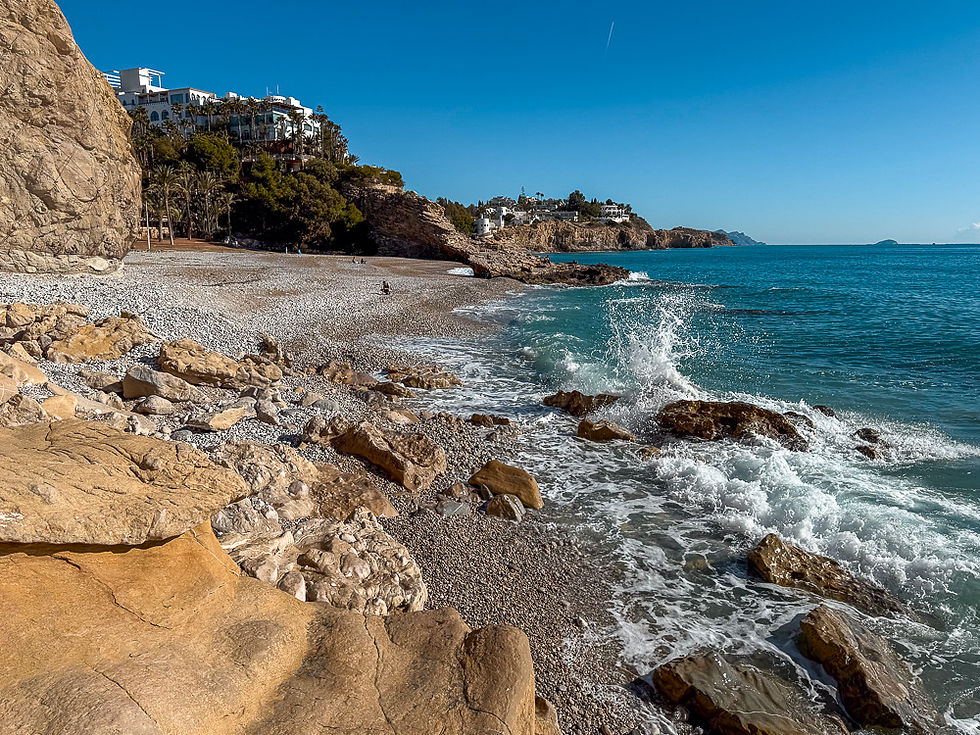
Playa La Caleta is located in the Montiboli area, where there are many luxury homes on the cliffs surrounding the bay, and where there used to be a large fashionable hotel that has now been partially converted into luxury apartments for rent. The old reception and some of the rooms are empty. The beach is 139 meters long, 20 meters wide on average and has a blue flag. To get there, you have to walk past the Hotel Servigroup Montiboli on a separate path reserved for the public. Most of the area inside the beach is private and only accessible to customers of the aparthotel, but the beach is open to everyone. In the hotel area there are swimming pools, tennis courts and bars. The beach has rocks and coarse gravel. It has a lifeguard in high season, foot showers, toilets and a beach bar.
Playa la Caleta is connected to the 222-meter-long Playa de L'Esparrelló (el Asparalló). The two beaches are separated by a small cliff that makes it impossible to walk from one beach to the other. The only way to get to the beach is to go down the steps from the Hotel Montiboli. Although this is formally one of the beaches of Villajoyosa, in reality it functions as a private, exclusive beach for the hotel guests. It has coarse sand and round stones.
To find your way, type Playa La Caleta into Google Maps. This will take you to a car park at the top of a steep hill that goes down to the Hotel Montiboli. The car parks at the bottom of the hill are private and not accessible to visitors. Walk down the steep hill. At the end you will find a path that leads past the hotel and down to the beach.
As a curiosity, it can be mentioned that two hippies checked into the hotel under the name "Mr. Martin and family" on June 12, 1972. Their real names were Paul and Lindy MacCartney and they brought their three children Stella, Heather and Mary. MacCartney was specially invited to attend the annual Festival de Benidorm and wanted a place where the family could be left alone from paparazzi and fans. At that time, there were many luxury hotels in the area, but the Hotel Montiboli was considered the most discreet and peaceful. With its location surrounded by steep cliffs with a private and closed beach far from surrounding towns, it was a sheltered place. The hotel had also had many other famous guests such as Julio Iglesias, Aretha Franklin and Camilo Sesto. Unfortunately, this says more about the grandeur of the past than about the current situation.

4 Playa de Bon Nou

Surrounded by 40-meter-high cliffs, Playa Bol Nou is a beautiful oasis with clear turquoise water. Since it is well sheltered by cliffs in a relatively small bay, there is often little wind and waves there. The beach has smooth, coarse-grained sand and is well suited for children. It has a blue flag, which is a mark of high cleanliness and quality. It also has public toilets, foot showers and is accessible to people with disabilities.
The beach is easily accessible from a nearby car park. To get there, enter Aparcamiento Playa Bol Nou in Google Maps. Then just walk up the hill to the west. You will see the beach as soon as you reach the top of the hill. If you walk in the opposite direction from the car park, you will reach Playa Paraíso. The car park is shared by both beaches.


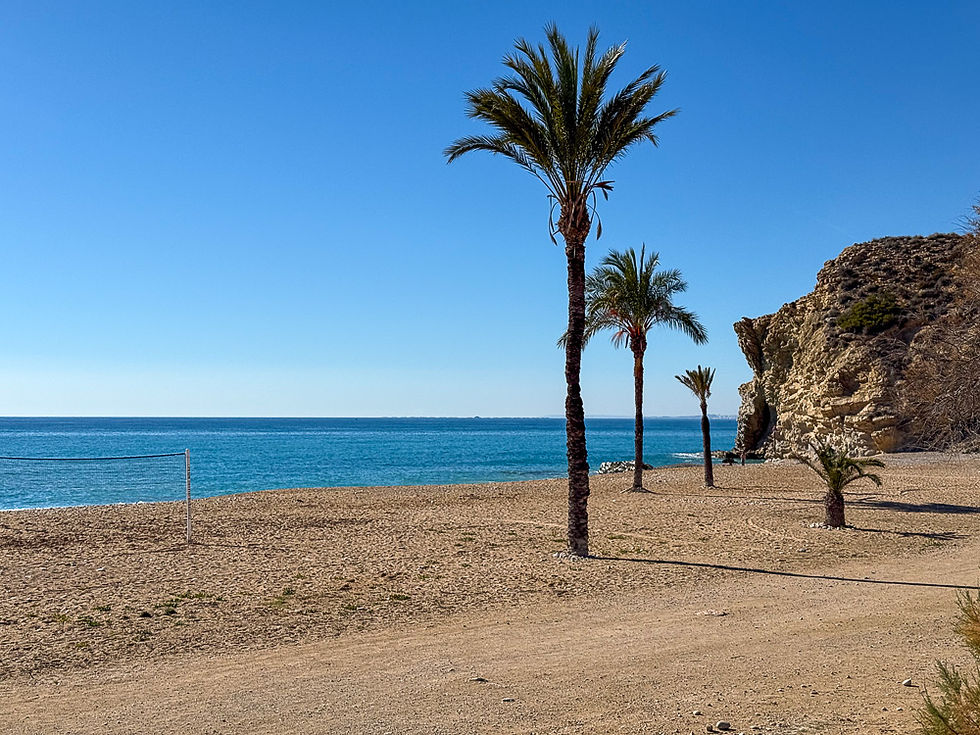
5. Playa El Paraíso

Playa El Paraíso is one of the nicest beaches in Villajoyosa. It is 1 km long, has an average width of 25 metres and has a mixture of fine and coarse sand and small rounded stones. It has a blue flag as a sign of high cleanliness and water quality and has a long promenade with palm trees. In high season there is a lifeguard and an open beach café with toilets. It has a foot shower, easy access and is to some extent adapted for people with reduced mobility. Although you can bring children, you should be aware that this is not a particularly child-friendly beach. After a few metres, it suddenly becomes quite deep. Small children will therefore not be able to swim alone. You should also be careful when there are big waves because it can be difficult to get back to land. It is an advantage to wear swimming shoes. There are cliffs at both ends of the beach. There is a campsite at the eastern cliff.
To get to Playa El Paraíso you can either park at Aparcamiento Playa Bol Nou or at one of the many spaces along the roads in the area. In either case, it is a short walk to the beach. You turn off at Paraíso from the N-332A where there are signs for the beach. Alternatively, you can type Playa Paraíso Villajoyosa into Google Maps.


6. Playa Puntes del Moro

Playa Puntes del Moro is a 210-meter-long beach area between the western end of the promenade in Villajoyosa town and the Malladeta cliff. It consists of rounded rocks and has relatively shallow water. The shallow water makes it child-friendly, but large rocks stick out far from the beach. You must therefore be careful when swimming or snorkeling. However, it is a nice place to snorkel with children as the water is relatively shallow and there are many small fish around the rocks. At the eastern end there are several large trees that are popular in the summer because they provide nice shade from the sun.
In 2023, extensive rehabilitation work was carried out at the western end of the beach. Large amounts of sand and rocks were removed to restore the area to its original state. This gave the beach a gentler slope and more space for visitors. In the high season there is a popular beach bar with toilets on the plateau inside. In addition, in the building just above the beach there is a bar that is open all year round. There are trash cans on the beach and some parking spaces nearby. The beach has no lifeguard or other facilities. You should wear swimming shoes. If you want a change from sunbathing and swimming, you can take a walking path from the beach up the hill to a large park with an archaeological excavation area (https://www.turideer.com/post/santuario-de-la-malladeta-en-historisk-utflukt).
The beach is located at the western end of Villajoyosa town. Type Cala de les Puntes del Moro into Google Maps. This will take you straight to the parking lot by the beach.


7. Playa Centre Villajoyosa
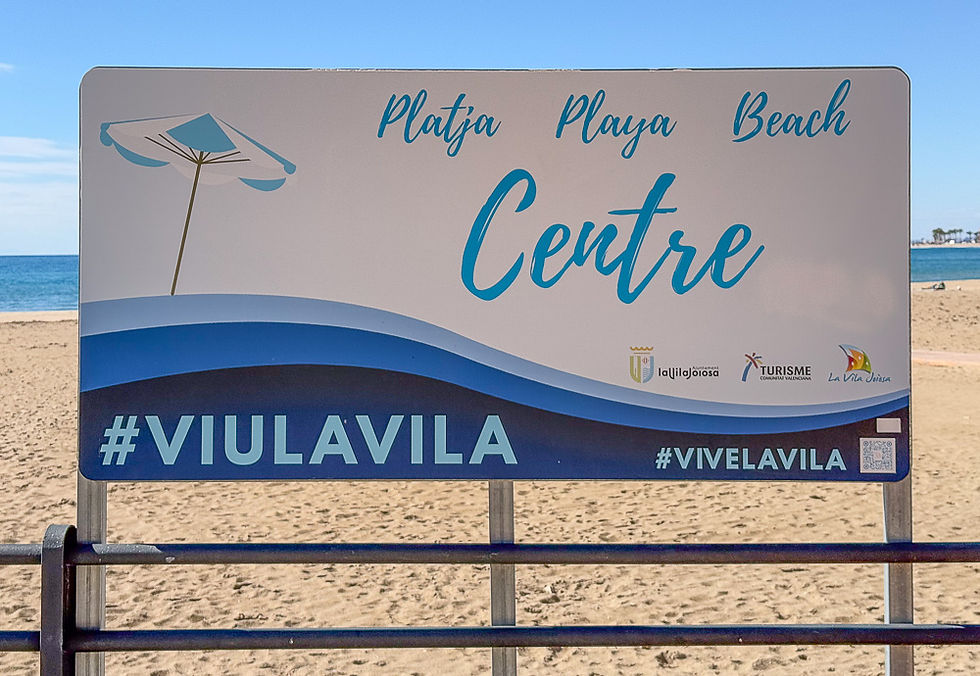
Playa Centre Villajoyosa is a typical urban beach below the old town of Villajoyosa. It is a full 1380 metres long, more than 30 metres wide and has a blue flag. It is bordered along its entire length by a wide promenade with many restaurants within. Under the widest part of the promenade, a large underground car park has been created with space for 280 cars. The beach is artificially landscaped with fine-grained white sand. It is shallow, very child-friendly, has a lifeguard, toilets, foot showers and is adapted for the disabled. It has play equipment for children, a net for beach volleyball and in high season also an inflatable bathing facility and boat and sailboard rental. In the harbour just to the east end of the beach you can rent water scooter. Please note that there can sometimes be strong and dangerous currents in the water. This is especially true when there are waves. Therefore, respect the flags that are hoisted to warn of dangerous conditions. You can swim safely when the green flag is raised, but be careful when the yellow flag is raised and avoid going into the water at all when the red flag is raised.
Originally, the beach was right up against the buildings. It consisted of rounded stones and coarse gravel and was quite narrow. However, in the early 2000s, a large EU-funded project was carried out, which extended the beach by several dozen meters and filled it with large amounts of fine-grained sand far out into the sea. In 2006, the underground parking garage was completed. The beach has held up very well. The sand has settled, and there has been no need to fill it up any more.
To get to Playa Centre, enter "Parking Doctor Esquerdo" in Google Maps. This will take you straight to the underground parking garage on the beach. Doctor Esquerdo is probably the city's most famous person. He was a pioneer in mental health and laid the foundation for modern treatment of mental illness. He was also a national politician and served in parliament for a long time.


The next three beaches, Playa Varadero, Playa Estudiantes and Playa Tío Roig, are located one after the other on the east side of the port, separated only by small cliffs. They are similar to each other and have many of the same qualities. They have coarse-grained sand and rounded small stones, are relatively shallow and are often exposed to waves. However, these beaches are not very popular, and therefore you can usually get plenty of space. The beaches are located on a route that runs along the coast from the port of Villajoyosa to Cala Finestrat and Benidorm (https://www.turideer.com/post/villajoyosa-benidorm-turvei-med-havutsikt-og-overraskelser).
Outside one of these beaches there is a Roman shipwreck. It is the largest Roman cargo ship found in the Mediterranean and is called Bou Ferrer after the diver who found the wreck in 1999. It was loaded with three thousand amphorae (ceramic jars), each containing 40 kg of fish sauce made from anchovies and mackerel. On both sides of the keel, 12 lead ingots were found, marked "Emperador Germanicus Augustus", and with the help of these, archaeologists were able to date the ship to the middle of the first century. Later studies have shown that the ship was probably manufactured in a shipyard in Naples, and that it set sail from the port of Cadiz sometime in the second half of the first century in the direction of either Rome or Narbonne. It is believed that the heavily loaded ship encountered problems on the way to the Balearic Islands, and that the crew tried to save the ship by letting the wind blow it towards land. There, however, it sank about 1,000 meters from the coast and remained undiscovered for almost two thousand years. Most of the valuable archaeological artifacts have been recovered and placed in the Villajoyosa Museum, but to prevent damage to the wreck, diving down to it is prohibited.
8. Playa Varadero

Playa Varadero, also known as la Almadraba, is the first beach you come to when you leave the marina. Here, there used to be a shipyard for building ships and a slipway for launching. The beach is named after the slipway, which in Spanish is called varadero. Boat building began as early as the 16th century when the Villajoyosa Royal Shipyard produced transport ships and warships for the Spanish Crown. During World War I, schooners and other large sailing boats were produced here. Since the increasingly larger boats required a slipway with greater depth, the shipyard was closed down in 1918. Some of the old equipment is on display on the beach.
The beach is 130 meters long, 30 meters wide and has a mixture of coarse-grained sand and small rounded stones. The water is shallow and you should be careful when swimming when there are big waves. At the beginning of the beach there is a permanent beach bar that is open most of the year. The beach has a blue flag, benches, trash cans, a lifeguard during high season and a foot shower. Of the three beaches, this one has the most visitors and fills up the fastest during high season.
To get to Playa Varadero, you can either park in the harbor and walk along the coastline or park in a small parking lot nearby. Type "Aparcamiento Playa Varadero" into Google Maps to get there.

9. Playa Estudiantes

Playa Estudiantes is 140 meters long and 8 meters wide. It is a beach without any special facilities, but since it is located next to Playa Varadera, you will be able to walk there to find toilets and a beach bar. The beach area is relatively narrow, especially at high tide, and therefore does not have room for many people. Since it is not very popular, you can sometimes have it to yourself. It has a mixture of coarse sand and small rounded stones and is relatively shallow. You should wear swimming shoes and be careful when there are waves, as it can be difficult to get back to land.
To get to Playa Estudiantes, follow the same route as to Playa Varadero.


10. Playa Tío Roig

Playa Tio Roig is the narrowest of the three beaches. It is 160 metres long, 6 metres wide and has an artificial slope down to the water. As with the other beaches, you should wear swimming shoes when swimming because it can be difficult to get out of the water. You should be careful when swimming when there are waves. This is not a child-friendly beach. It has no facilities, but it is a short walk to Playa Varadero where there is both a beach bar and toilets. To get to it, follow the same path as to Playa Varadero.

11. Playa El Torres

Playa El Torres is a 560-meter-long and 10-meter-wide beach with coarse sand and small round stones. It is a beautiful and child-friendly beach with shallow water. Along the beach there is a promenade in the shade of large trees. The beach has previously been mostly used by guests of a campsite just inside and by permanent residents nearby. However, over the past couple of years, there has been a large development of housing in the area, and one can therefore expect the beach to be more visited in the future. For those who like shade, there are many old trees with large shady treetops to seek refuge under. The beach has all the facilities such as a lifeguard (in high season), toilets, foot showers and a beach bar. It has a blue flag as a sign of high water quality, cleanliness and environment. It is a popular starting point for kayaking and diving.
To get there, enter Playa El Torres in Google Maps. You will then be directed to the east side of the beach via a newly built road that leads to a parking lot with space for many cars. When driving the N-332 from Villajoyosa towards Benidorm, take the second exit to the right, marked Playa El Torres.


12. Cala Fonda

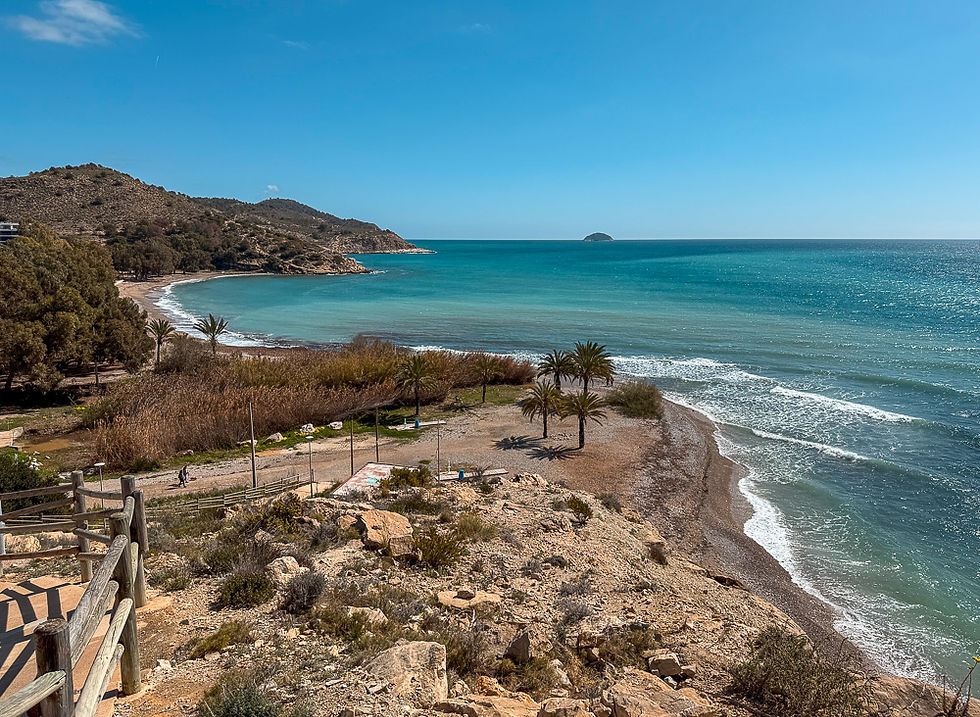
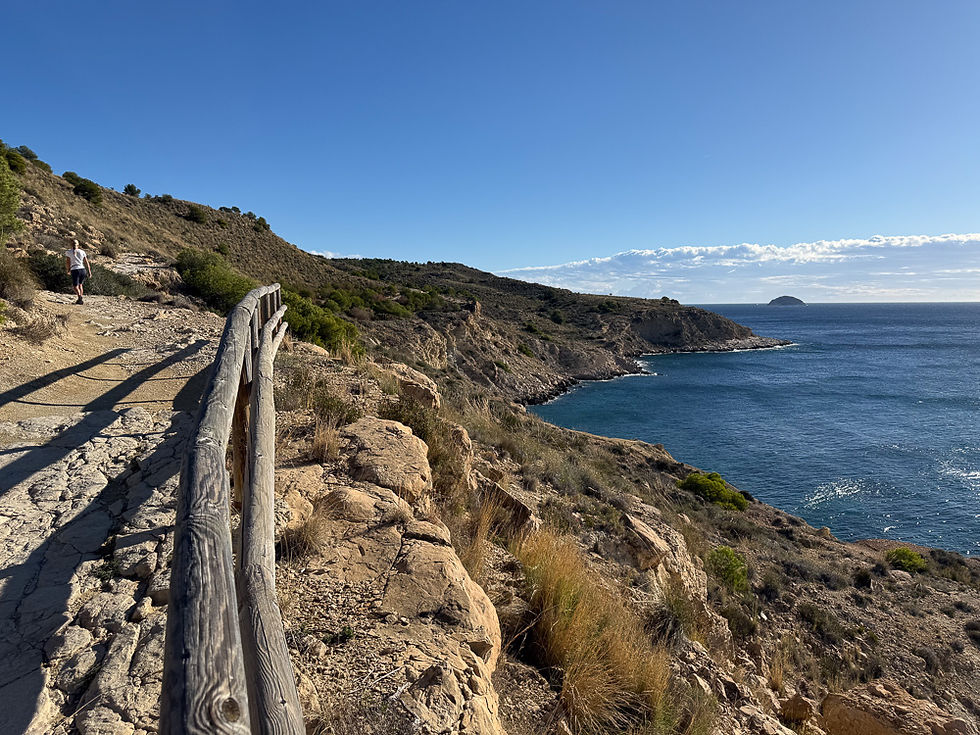
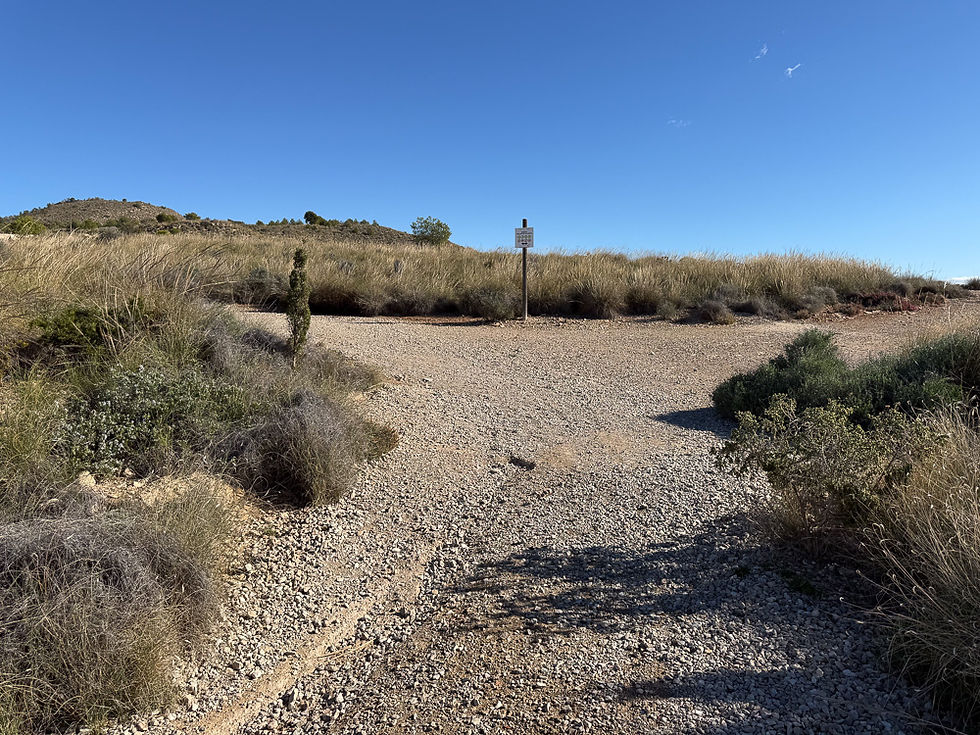
Cala Fonda is a narrow cove on the hiking trail between Playa El Torres and Cala de Villajoyosa. The hiking trail runs along the coast with beautiful views of the Mediterranean. After about 800 meters you reach an area where paths go down to a plateau by the sea. It is difficult to get down to the water, but there are good places for sunbathing.
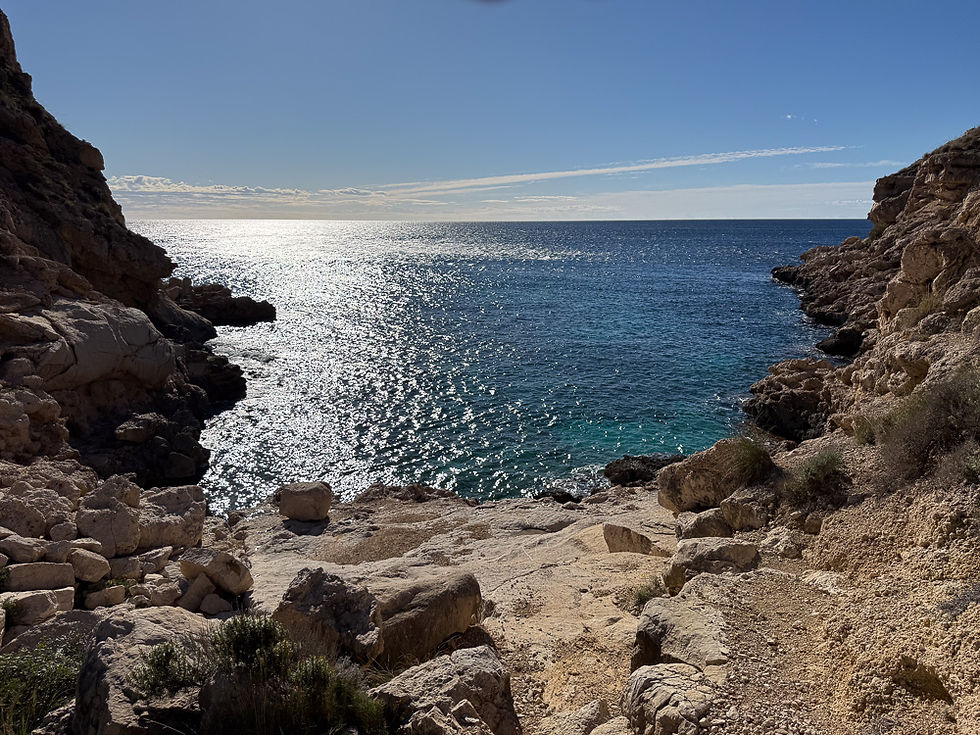
After about 1 km from Playa El Torres you reach a deep, steep gorge with a beautiful little bay at the bottom called Cala Fonda. There is a path along the west side of the gorge down to the bottom where you will find a large flat rock and a coastline with sharp volcanic rocks. The descent is not dangerous, but can be uncomfortable for people with a fear of heights. This is not a place to take children, but for adults it can be an idyllic place for sunbathing and swimming, especially since you often have the place to yourself. You should wear good shoes when going down, and you should wear swimming shoes when swimming. It is not suitable for swimming when there are big waves, but the high cliffs often provide good protection from both wind and waves.
To get there, the easiest way is to park at Playa El Torres on the east side of the beach. From there, follow the hiking trail towards Cala Finestrat and Benidorm. The bay is located about 1 km from Playa El Torres. Enter Aparcamiento Playa El Torres in Google Maps.



13. Playa Racó del Conill

Playa Racó de Conill is a naturist beach located about 3 km from Benidorm in a bay surrounded by high cliffs. The name Conill probably comes from the Valencian expression "anar en conill" which means "to walk naked". It is 160 metres long and 4 metres wide and is divided in two by a small headland. In the eastern part there is a small sandy beach with fine sand. In the western part there is coarse gravel and small stones. You can also swim from the rock on the small headland.
The nudist tradition dates back to the 1960s when hippie movements and other currents led to a softening of norms and rules regarding nudity. Since then, the beach has always been reserved for nude bathing. However, due to the increasing use of swimwear after the turn of the millennium, a group of activists started a project "Proyecto Racó del Conill Nudista" to preserve the tradition of nude bathing. From 2016 to 2020, they worked to spread information about nude bathing. They strongly encouraged that people should be naked when visiting this beach to avoid jeopardizing tradition. Today, this is still a naturist beach where nudity is the norm.
In 2019, a plaque was erected in honor of Antonio Torralbo, who had been volunteering and keeping the beach clean for many decades. The plaque can be seen at the top of the cliff where you can look down to the beach.

14. Playa Cala de Finestrat
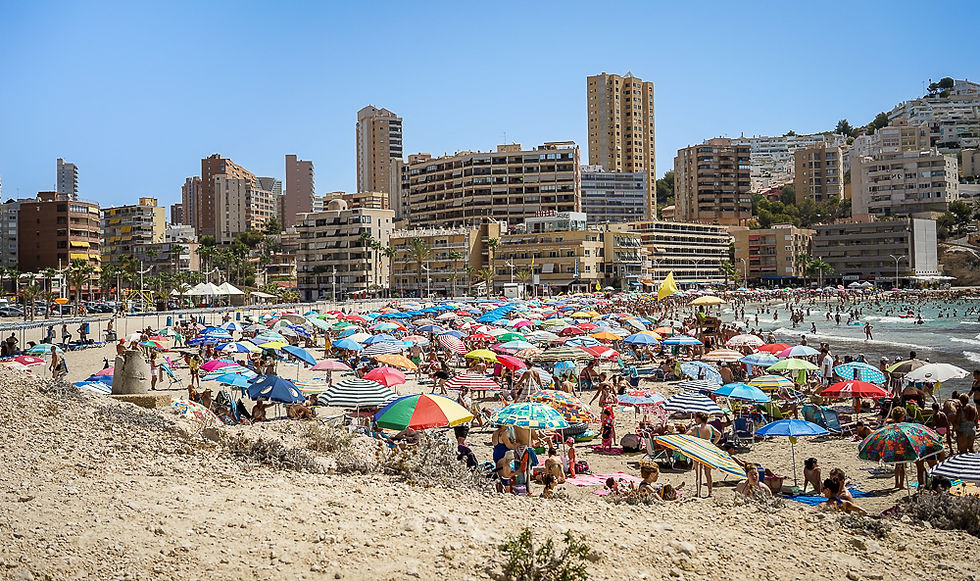
La Cala de Finestrat is located right up to the border of Villajoyosa, and is therefore included in this list. It is difficult to find reliable records of where the municipal boundaries are. It has been claimed that this is a beach that Finestrat and Villajoyosa have together, and that the western part belongs to the municipality of Villajoyosa and the eastern Finestrat, but the correct thing is probably that Villajoyosa's borders run at the beginning of the sandy beach, and that Finestrat's shoreline extends 267 meters from this to the river that flows out at the eastern end of the beach. East of the river lies Benidorm. It is a typical urban beach with many high-rise buildings around it. The entire beach is 300 meters long. It is shallow and has fine-grained, white sand. The water is clean and clear, and the cliffs around the bay and the large mountain Puig Campana in the background ensure that there is often little wind and waves. The beach is popular and fills up quickly by the many people who live nearby. You should therefore be there early to find a place. You should also expect it to be very full. It has a blue flag and all the necessary facilities. There are many restaurants along the beach.
Finestrat is the municipality in Spain with the shortest coastline. The old town center of Finestrat is located 8 kilometers inland up in the mountains by the iconic mountain Puig Campana with the distinctive notch on top. The reason why the municipality has a narrow strip of land from the city down to the sea can be found far back in history. When pirates were at their worst along the east coast of Spain between the 16th and 19th centuries, a warning system with watchtowers was created along large parts of the coast. The towers were located on top of cliffs with a clear line of sight to each other. They were manned by soldiers who warned with fire and smoke when enemy ships approached. To share the burden of guarding and defending, inland municipalities such as Finestrat were allocated a small part of the coast so that they would also feel obliged to contribute soldiers. Today this is an oddity with no practical significance, but on the cliff to the west you can see one of the watchtowers from the time of the pirates. There is a path up to Torre d'Aguiló, which was built in the 16th century, and the great view makes it well worth the trip.
More excursions: www.turideer.com
Excursion of the week: The 13 best beaches in Villajoyosa


Comments