


Norsk Folkemuseum on Bygdøy - open-air museum with buildings and objects from the Middle Ages to the present day

The Norwegian Museum of Cultural History on Bygdøy has 158 antiquarian buildings and approx. 150,000 objects that show how people have lived in town and countryside from the Middle Ages to the present day. The buildings from the countryside have been transferred from all over the country, while the buildings in the "Old Town" have been transferred from Oslo. Here you can walk around on gravel roads in rural nature and see old, well-preserved wooden houses from different eras and places in the country while sheep graze and farmers harrow on small fields. In this article the museum is presented with text and pictures.

In 1881, King Oscar II of Sweden and Norway had five buildings moved from villages around the country to Bygdøy. These became the core of Oscar II's Collection, the world's first open-air museum. The Folkemuseet, which was founded in 1894, purchased a plot of land on Dronninghavn lystgård right next to Oscar II's Collection in 1898. After the dissolution of the union in 1905, King Oscar donated his collection to the Norwegian state, and this thus became part of the Folkemuseet. Later, several other collections were incorporated, for example the Sami collection from the University's Ethnographic Museum, which was incorporated in 1951.

In 2006, several museums were merged into the Norwegian Museum of Cultural History Foundation. Today, the Norsk Folkemuseum on Bygdøy is one of the departments of this foundation, along with the departments of Bogstad Gård, Eidsvoll 1814 and the Norwegian Maritime Museum. The purpose of the Norwegian Museum of Cultural History Foundation is to document life and living conditions in Norway. The foundation is independent and is financed mostly by government support, but also to a certain extent by ticket revenue.


The Norsk Folkemuseum is one of Europe's largest and oldest open-air museums. It is a national cultural history museum with many objects from different eras that tell something about people's lives from the 16th century to the present day. Most of the objects are exhibited in the large brick buildings near the entrance. However, the largest part of the museum is still an open-air museum. Below are some pictures from the antiquarian buildings.


The Old Town is located at the opposite end (south) of the exhibition area. When you enter the square, turn left. There you enter a small town with cobblestone streets, old streetlights, wooden houses from the 18th century and large brick buildings from the 19th and 20th centuries. Many of these buildings were supposed to be demolished but were dismantled and moved to the Norsk Folkemuseum where they were rebuilt. Here it is like walking in a time machine. In one quarter you are in a suburb of the 18th century with low wooden houses and outhouses, in the next you are in a more typical city center with tall brick houses. You can enter most of the houses and see how people lived. In the newest brick house that was moved in 2000, some of the apartments are furnished with IKEA furniture that at least adults will remember well.

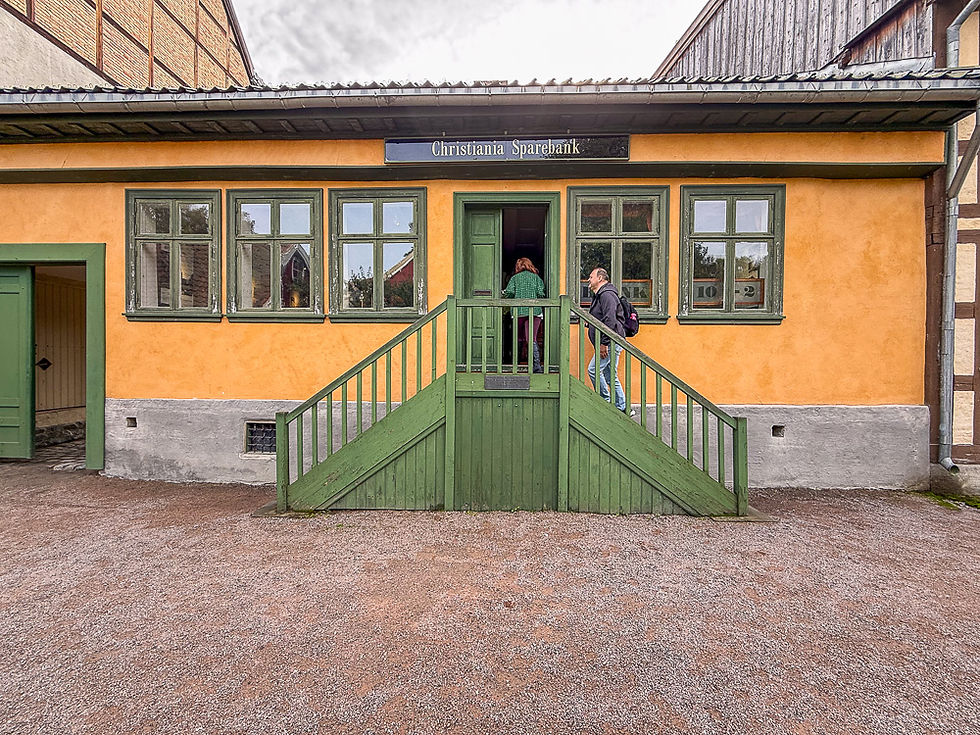
From the large square, turn left at the yellow house in the picture above. This will take you straight into the Old Town. The first part contains a collection of wooden houses from Gamle Hammersborg. It is in the center of Oslo today but was a suburb of the city itself when it was built in the mid-18th century. Many of the wooden houses in Gamle Hammersborg were in poor condition, and the intention was to demolish them. Fortunately, they were moved to the Norsk Folkemuseum instead so that we can see them today.


The city streets are from different eras. There are examples of large mansions from the west end and large brick houses from the east end, a gas station, bank, liquor store and pharmacy. There is also a large pharmaceutical museum and a museum that shows how paint was made 100-200 years ago.




More excursions: www.turideer.com
Excursion of the week: Norsk Folkemuseum on Bygdøy in Oslo
Suitable for: Everybody. Stroller and wheelchair are ok on the paths but not inside the buildings.
Get there: Enter "Norsk Folkemuseum" in Google Maps and you will be directed to the parking lot outside.


History unit on ciphers, so I ran a quote from the reading through this cryptogram generator. Turned the letter hints off for the older group and left them on for the younger one.