top of page

Hike from Altea to Altea Vella - lush orchards, peaceful narrow streets

  • Writer: Admin
    Admin
  • 5 hours ago
  • 5 min read

Both Altea and Altea Vella have a long history. In historical times, the area was first populated by the Iberians around 400 BC. Later, the Romans and then the Moors took control before the Spaniards took over. Altea and Altea Vella are located on either side of the valley and the river río Algar. In this area of ​​about 4 kilometers there is a lush terrain with orchards and fields. The article describes a hike from río Algar to Altea Vella.


Hvite murhus i Altea Vella

The walk starts on the footpath by the Río Algar near the mouth of the river where the settlement of Altea stops. It continues along the river up the valley for about 500 metres where the footpath joins a road. From there you walk on the road for a short distance parallel to the motorway before entering an area of ​​villas, orchards and fields. Finally you end up in the lower part of Altea Vella. The route with road junctions is described in more detail in the pictures below.


Mennesker går på gangvei ved siden av gule markblomster ved río Algar i Altea
Park your car at the old market square in Altea. Cross the road and continue on the walkway along the river on the other side.

En rad døde trær ved río Algar i Altea

Frodig og fruktbart område ved río Algar med Sierra Bernia i bakgrunnen
The Altea Valley is located in the area between the Sierra Bernia mountain ranges, shown in the photo above, and the Sierra Gelada further southwest. As you walk along the river, you have constant views of the Sierra Bernia.

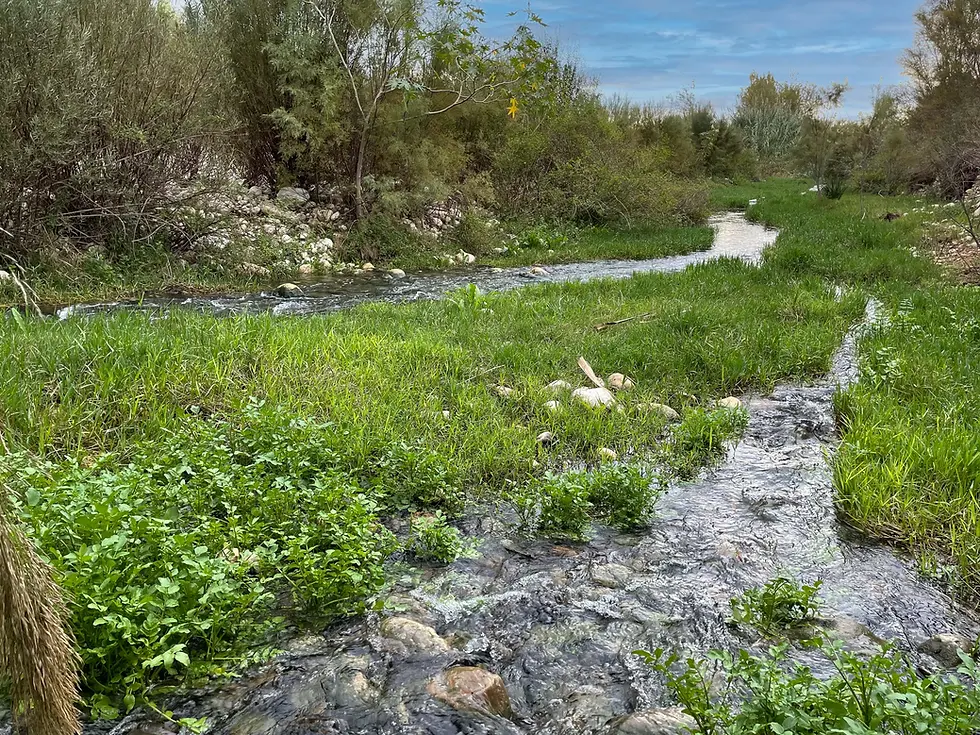
Rennende vann i río Algar ved Altea
Although most of the water flow in the Algar River has been drained into irrigation canals for agricultural areas, the riverbed is still very lush, as shown in the photo above.

Område med benker under trekroner ved río Algar i Altea

Bilvei over bro over río Algar i Altea-dalen
Continue on the footpath under the motorway. After approx. 500 metres it joins the road. Continue on this over the river and straight ahead towards Sierra Bernia parallel to the motorway.

Veikryss i Alteadalen
When you reach this intersection, turn right onto the gravel road.

Grusveier skiller lag i Alteadalen
When the gravel road splits in two, go right.

Benk og lite alter i veiskille i Alteadalen
At the crossroads with the bench and that altar cabinet, go left.

Frodig frukthage i Alteadalen
It was the good and steady supply of water that first led to the establishment of settlements in the Altea Valley and a trading post at the mouth of the Río Algar. Even today, the valley appears lush and fertile, even though the flow of the river is small because most of the water is directed to the agricultural areas via an ingenious system of open and underground canals. This efficient irrigation system was established already in Roman times and is the basis for the continued large production of citrus fruits, almonds and nisperos in the Altea Valley.

Nisperos-frukt på tre i Alteadalen
Nisperos - or Japanese medlar as it is called in Norwegian - is a sweet fruit that is widely grown in the Altea Valley.

Rikelig med appelsiner på trær i Alteadalen
Many of the orange plantations have several varieties of oranges that ripen at different times of the year so that there are almost always ripe oranges on the farm. Sometimes different varieties are grafted onto the same tree, other times the different varieties grow on different trees.

Menesker går til venstre i veiskille i Alteadalen
As the road goes up a hill, turn left where it meets a crossroad. It continues through a small forest.

Mennesker går på asfaltvei i Alteadalen

En gruppe mennesker går over fotgjengerfelt i Altea Vella
When you reach the main road, first turn left and after 50 meters cross this pedestrian crossing and then onto the road that turns right immediately after the pedestrian crossing. You are now in Altea Vella. The old town is just off this intersection.

What is now Altea is located on a cliff to the west of the Algar River. Originally, however, the area between the Algar River and the Sierra Bernia was called Altea, while today's Altea was called Albalat. After several unsuccessful attempts to increase the population of the original Altea, it was decided in 1617 that the village of Albalat would become the new Altea. Altea Nuevo (new Altea) then received an official Carta Puebla, while old Altea lost its village rights and was given the name Altea Vieja (old Altea), which over the years was simplified to Altea Vella. The official year of birth of Altea is therefore 1617. Eventually, Altea Nuevo was simply called Altea, while Altea Vella kept its "surname".


Fasade med mange blomster i Altea Vella
Facade at the church square in Altea Vella

Kirkebygning med kirkeplass der det sitter mennesker i Altea Vella
As in most towns and villages in Spain, the church has a central place. The Iglesia de Santa Ana in Altea Vella was built in 1885. It was for a long time a subdivision of the church in Altea, but was elevated to its own parish church in 1953. It is likely that a mosque may have stood on this site when the Moors lived in the town, but after the Moors were driven out in the 13th century the population was greatly reduced, and by the 16th century the village was practically abandoned. Therefore, no new church was built until there was a population base for it.

The street structure of the old town of Altea with its narrow winding streets dates back long before the city received its Carta Puebla. It was established as early as the period between the 8th and 13th centuries when the Moors ruled there. The buildings were later renewed to meet the needs of the Christian population that took over from the Moors, but the street plans were preserved, and most of the current buildings date back to the Middle Ages. In Altea Vella, the street plans from the Middle Ages have also been preserved, but the houses are much more recent. They were built in the 18th and 19th centuries and have been rehabilitated in recent years so that they are quite modern. What still gives you the feeling that Altea Vella is a medieval town is that the houses are built in a typical Mediterranean style, and that the new houses are built on top of the foundations of the old ones so that the narrow, winding and steep streets are retained.


Smal gate med steinbelegg i Altea Vella
The narrow, winding and steep streets are picturesque, but not very suitable for cars. The street structure and whitewashed houses give the impression of being in a medieval town, but the buildings that stand there today were built in the 18th and 19th centuries.

Smal pittoresk gate i Altea Vella

Smal og bratt gate med trapp på siden i Altea Vella

Mann går i smal bygate med kirkekuppel i enden i Altea Vella

Smal gate med sorte brostein i Altea Vella

Stasjon i Vía Crucis i Altea Vella
In 1833, the Vía Crucis (Stations of the Cross) was established in Altea Vella. Then the statue of Christ came to the village. The following year, a cholera epidemic broke out in Altea, but the inhabitants of Altea Vella were spared. This strengthened the inhabitants' devotion to Jesus, and the Vía Crucis was dedicated to the Santisimo Cristo de la Salud.

Gangvei som går i sikksakk oppover skråning med stasjoner fra Vía Crucis i Altea Vella
The main part of the Via Crucis is located in an area at the back of Altea Vella called El Calvari. Here, 14 stations are set up with images of different parts of the suffering story of Jesus up to the crucifixion. At midnight on Good Friday, a theater group performs the various events and the procession goes from station to station.

Eksempel på bilde i stasjon for Vía Crucis i Altea Vella
Example of image in the 14 stations.

More excursions: www.turideer.com


Excursion of the week: Hike from Altea to Altea Vella along the Algar River and through the Altea Valley.


Suitable for: Everyone. Strollers and wheelchairs are welcome.


Length: 4 km each way, 8 km total. Back and forth the same way.


How to get there: Park in the free car park at the sports complex on the east side of Altea down by the river. Type "Free Car Park" or "Carpa Festera" into Google Maps and you'll be taken straight to the car park. Cross the road to the footpath on the other side at the roundabout. That's where the route begins.


Comments


© 2016 by Liv and Geir Stene-Larsen.

  • Facebook
  • Instagram
bottom of page