


Alicante's green lungs - parks in Alicante

Alicante is one of the fastest growing cities in Spain. There has been a lot of construction, but fortunately they have managed to preserve some natural areas where there is both running water, plants and palm trees. They have also managed to set aside space for several parks of different sizes where you can go for a walk, exercise or just relax in the shade of a tree. This article describes the most important parks in the city of Alicante.

Parks are important recreational areas for people living in cities. In Alicante there are several large parks, but also many that are only a few hundred square meters surrounded by busy roads in residential and commercial areas. Therefore, you don't have to go far to find plants, green trees and shrubs. In this article, we describe the most important parks:
Parque Plaza Gabriel Miró
Parque de Canalejas
Parque Portal de Elche
Parque Monte Tossal
Parque lo Morant
Parque la Marjal
Parque El Palmeral de Alicante
Parque Plaza Gabriel Miró
is a square park just inside the harbor. It was originally called Plaza de las Barcas because at that time boats could sail there. The formal name was Plaza de Isabel II, before it was given its current name after the famous writer Gabriel Miró from Alicante. In the park you will find several hundred-year-old fig trees that have the status of monumental trees. They have trunks several meters thick and large aerial roots. In the middle of the park is the La Aguadora fountain with a sculpture in the middle. There is also a bust of Gabriel Miró. Here you can sit on one of the benches and relax under the shade of the tree crowns that cover almost the entire park.


Parque de Canalejas
is located in the continuation of the famous promenade Explanada de España by the port of Alicante. It was created in 1886 on an area where there had previously been a boat slip, and is the oldest park in the city. It is named after the famous Gallic politician José Canalejas who represented Alicante in parliament and who became President of Spain. The park is an elongated, narrow park consisting of a wide promenade with an avenue of large fig trees on both sides that provide shade to the promenade. It has several monuments and statues and monumental fig trees. The park is well suited for a walk on a hot summer day.


Parque Portal de Elche
is a small square park a few hundred meters inside the port of Alicante. The square was originally called Plaza de las Horcas (the place where criminals were executed). It got its current name in 1869 because it marked the start of the road to Elche, which is outside the city limits of Alicante. It is divided into four green areas by walkways that lead to a characteristic hexagonal kiosk in the middle. Today's kiosk is a reconstruction of the one that was demolished in 1970 and now functions as a café and bar. The park is best known for its four large, old fig trees (Ficus Macrophylla) that are protected and have a trunk circumference of 6 meters. Here you can have some food or drink at the kiosk or at a restaurant outside the park.


Parque Monte Tossal
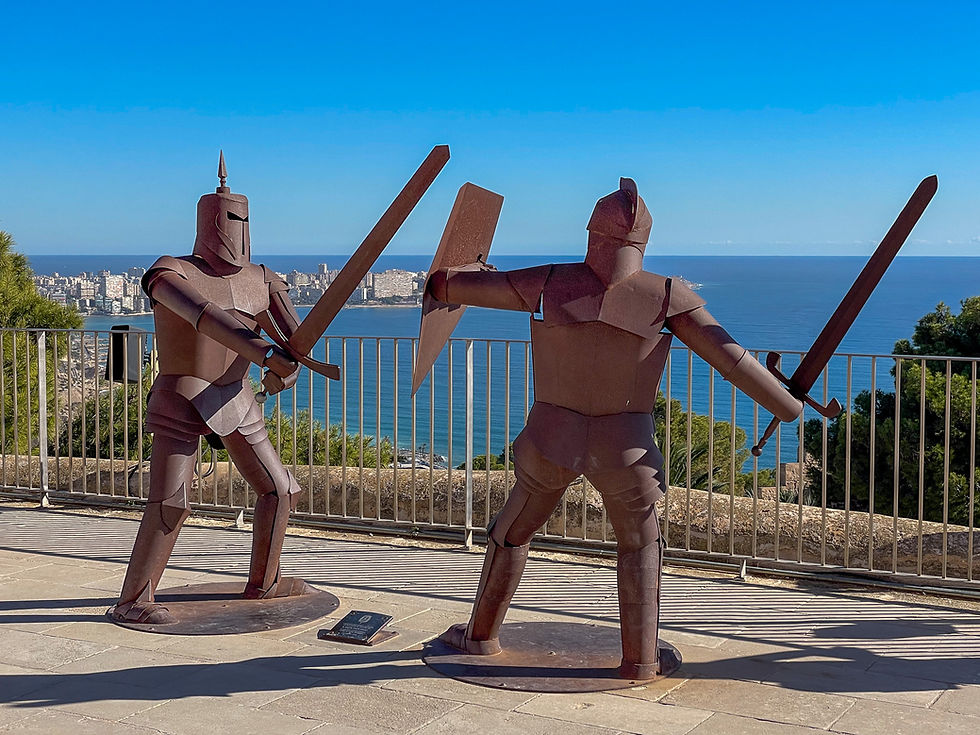
surrounds the Castillo de San Fernando which is located on top of the 87-meter-high Monte Tossal. The park is 6.3 hectares in size and is located in the center of Alicante near the large castle of Santa Barbara. From the top of the castle you have a nice view of the whole of Alicante, the port and the coast beyond. It is a nice park for a walk, but the biggest attraction is the castle and the view. There are several sports facilities in it, including a skateboard track. The park is relatively new. It was designed by the architect Rafael Rivera and inaugurated in 1995.


Parque lo Morant
is the largest park in Alicante with an area of 12 hectares. It is flat, located in the northern part of the city and consists of gravel plains, flower beds, palm trees and shrubs, as well as activity areas, pitches for indoor football, tennis, changing rooms, a children's playground and an artificial pond. It also has an amphitheatre used for concerts and cultural events. Here you can walk or run around the walkways or relax on a bench.


Parque la Marjal
is an important recreational area, but also Spain's first urban flood park. It is designed to prevent flooding by collecting water during heavy rainfall. It can store up to 45,000 cubic meters of water and has prevented flooding in the surrounding residential areas several times since its opening in 2015. When the rainy season is over, the collected water is pumped out to a treatment plant and reused for irrigation in the city's parks. The park is man-made, but it imitates the natural wetlands that previously prevented flooding, and which in many places have been drained and converted into urban areas. The park has become a bird sanctuary where more than 100 different species have been observed, including several rare and endangered species. Due to the water and humidity, the temperature in the park is 5 degrees lower than in the surrounding areas. It is therefore also a place of climate refuge for the city's population. The park has two artificial ponds and a waterfall. The soil excavated when the dam was built was used to create a small hill that offers a nice view of the park, the city, and the mountains in the background. The park is located in the San Juan district.


Parque El Palmeral de Alicante
is perhaps the most beautiful of the parks in Alicante. It is located at the southern entrance to the city, right by the sea. It is only 40 meters wide and 320 meters long, but here you will find 7,000 palm trees of different types, walking paths, bridges, ponds and waterfalls, a bike path, a skateboard track, a playground, a fitness area and an outdoor auditorium used for cultural events. It also has toilets, a bar where you can buy some food and drinks and several picnic areas where you can eat your own food. It is open from 09:00 to 00:00 in the summer (shorter in the winter) and you are allowed to bring your dog. The area was originally part of a large farm called El Carmen. After most of the farm had been sold and used for housing and commercial activities, the Alicante municipality bought the remaining part to preserve the unique nature. However, the park was only inaugurated in 1997. The park is described in more detail in a separate post (https://www.turideer.com/post/el-palmeral-de-alicante-park-med-palmer-elver-og-innsjøer-1).


More excursions: www.turideer.com
Excursion of the week: Alicante's green lungs - parks in Alicante
Opening hours: The small parks around the city are of course open 24 hours a day, but the large parks such as Parque El Palmeral de Alicante, Parque la Marjal and Parque lo Morant are closed at night. The usual opening hours are from 09:00 in the morning to 00:00 in the evening in the summer months and somewhat shorter opening hours in the winter months.


Comments