


Alcoy, the city of bridges - authentic and historical - what to see in Alcoy?

In a valley surrounded by mountains and natural parks 60 kilometers north of Alicante lies a city with a long history. In Alcoy you get a more authentic picture of city life in the Valencian region than you do in the popular coastal cities. The city is known for its many bridges and viaducts that cross rivers, gorges and valleys, but you can also see modernist architecture and eat local dishes in traditional restaurants. The article describes what to see in Alcoy.

Alcoy has approx. 60,000 inhabitants. It is located at the bottom of a valley where several ravines and valleys with rivers meet. This leaves its mark on the city. In this article we describe the most characteristic things about Alcoy:
the old town
the history
the architecture
the churches
the parks
the bridges
the nature
The old town
The original medieval town has not been preserved in its entirety as can be found in many other Spanish towns and villages. Since the industrial revolution came early in Alcoy, factories were built inside the town itself and not outside as has been done in many other places in the country. There are still areas with narrow streets built for pedestrians and horses, but they have a mix of new and old buildings and are not as picturesque as in the well-preserved medieval towns.


Placa de España de Alcoy is located in the middle of the old town. It is a good starting point for exploring the city. There is a Tourist Information Office, which you should visit to get maps and directions to important sights. Most of these are within walking distance from this square.


The history
The area where Alcoy is located has been inhabited since 60,000 years ago, when Neanderthals dominated. In historical times, it was first a military camp for Islamic forces, hence the Arabic name Alcoy, meaning camp. After the Romans conquered the area, a group of houses were built that developed into a small urban community. However, the city itself was not established until 1256.


Alcoy has an interesting industrial history. In the Middle Ages, water power was the only source of energy. In Alcoy, mills could be built along several of the rivers, and these could be used to operate equipment and facilities required to produce woolen cloth (filling machines, spinning machines, looms). Sheep farming was an important part of agriculture, and there was therefore good access to wool. Since the climate was both cooler and wetter than on the coast, they got wool with better fiber quality. In addition, the workers had good working conditions. These competitive advantages meant that Alcoy quickly developed into one of Spain's most important textile cities. Later, both the paper industry and the chemical industry came, both of which depended on access to water and energy. In the 19th century, Alcoy was ready for the industrial revolution. The city had the labor force, expertise, infrastructure and capital needed to develop a dense, efficient industrial society.

There are marked trails through cultural and natural areas near the Molinar River where you can practically walk through the city's industrial history. You can see ruins and remains of textile factories, paper mills and mills, canals, water channels and locks, foundations for water wheels and old factory buildings that are now partly hidden by vegetation, but which used to stand in rows along the riverbed. Unfortunately, these trails are currently (2026) difficult to access because the road at the El Molinar roundabout where the trails start is being rebuilt so that you cannot get down to them.
Today, much of the industry has closed down, and on the west side of the city, old factories have been replaced by a modern polytechnic university.


One of the historical sights worth seeing is the Refugio Cervantes. Alcoy became a priority bombing target for the Germans during the Civil War because the many textile factories were important for supplying the garrison with uniforms and other materials. The shelter was built inside the mountain to provide protection to the surrounding population. It now functions as a museum. Refugio Cervantes is located about 15 minutes on foot from Placa de España.


The architecture
Alcoy is one of Spain's most important modernist cities. You can see traces of this when you walk through the oldest parts of the city, where you will find, among other things, the famous buildings Casa del Pavo (Turkey House) and Círculo Industrial. The latter was a cultural institution founded on January 1, 1868. These and other modernist buildings were built on plots where there had previously been buildings from the Middle Ages. Today, therefore, there is a mixture of old buildings, modernist buildings and buildings from our time in the narrow streets that were made in the time when horse and cart were the prevailing means of transport.


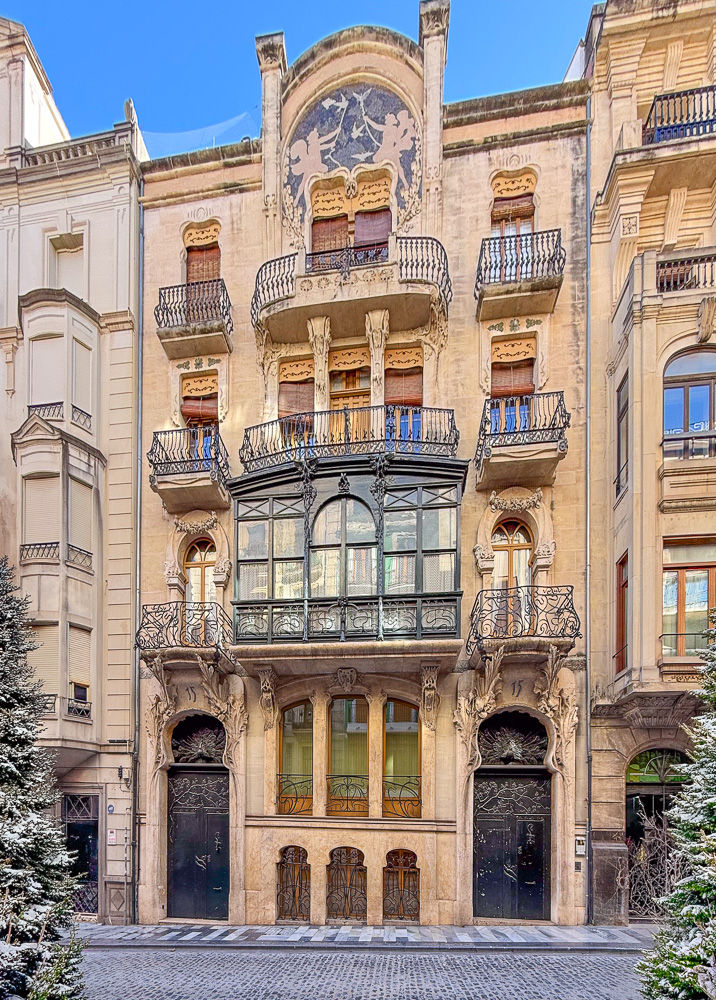


The churches
Alcoy, like most Spanish cities, has beautiful churches. The most famous are the Iglesia de Santa María, Iglesia de San Mauro y San Francisco, Santuari de Maria Auxilladora and Iglesia de San Jorge. All are within walking distance of Placa de España.


The parks
Alcoy has many small parks, but the most famous is Parc La Glorieta. It was created in 1836 in the orchard of the San Francisco Monastery and is the oldest park in Alcoy. The park as it stands today was designed by the same architect who designed many of the modernist buildings in Alcoy, Vicente Pascual Pastor. It was completed in 1899 and has remained largely unchanged since. Below are pictures of some of the parks.


The bridges
Alcoy is known for its many bridges. Some of them are centuries old, others are new. Some are interesting architectural structures, others are simple and featureless. Some are for railways, others for cars and some only for pedestrians and cyclists. Together they make an important contribution to the city's character. It is difficult to state exactly how many bridges Alicante has, as it depends on the definition used. The largest and most famous bridges are:
Puente de Penáguila - the oldest bridge in Alcoy, built in 1712 on the foundations of a medieval bridge
Puente de Cocentaina - one of the oldest bridges from 1780 built on the ruins of previous bridges dating back to the 17th century
Antiguo Pont de Sant Roc (Puente de Sant Roque) - old stone bridge from 1861 that crosses a small river in the Barranco de Soler
Puente de María Cristina - a historic bridge from 1828-1838 that crosses the Barxell/Riquer River, impressive engineering
Puente de San Roque - 19th century stone bridge at Barranco de Soler
Puente de la Pechina - old stone bridge from 1863 over the Benisaidó River with five arches high above the terrain
Puente de San Jorge (Pont de Sant Jordi) - the city's most famous bridge, a monumental Art Deco structure from 1931 that crosses the valley of the river Riquer/Serpis
Puente de Fernando Reig - a modern cable-stayed bridge from 1987
Pont de les Set Llunes (Puente de las siete lunas) - a tall, old viaduct (bridge over a valley) with large arches that was built for a railway line that never came into use.
Ponton del Terrer (Ponton de San Jaime) - a 53-meter-long concrete city bridge from 1933 that connects districts in the city center, not spectacular, but historically important
Viaducto de Canalejas - a large, monumental viaduct (bridge over a valley) from 1907 consisting of a long iron structure on concrete pillars, one of Spain's most outstanding engineering works.
In addition, there are newer, urban bridges such as Francisco Aura, Rafael Terol and Batoy and lesser-known, but old bridges such as Tossal (1712), Alcázares (1780), Cadedesigne (1790) and several others. In total, it is stated that there are more than 20 bridges and viaducts if you also count the smaller ones.


The nature
The old town of Alcoy is located on a plateau raised above the intersection of the three valleys of Riquer, Benisaidó and Molinar. The steep slopes down to the rivers gave the city a natural defense that was reinforced by a city wall at the top. As the city grew, however, it became necessary to build bridges over these rivers and valleys in order to create new districts on the outside. This peculiar urban formation can be seen clearly from the Puente de San Jorge or the Puente de María Christina. There, you get a good view of the valleys and factory areas along the rivers.


Alcoy is well sheltered, surrounded by mountains and beautiful natural parks. This has given the city a slightly cooler and more stable climate than on the coast. It has also provided a basis for tourism. Alcoy is currently focusing heavily on cultural heritage tourism, but the area around Alcoy is also popular as a destination for hiking and cycling. Some of the tours start from the city, others require you to drive a few kilometers.
Via Verde de Alcoy
Spain has preserved old, disused railway lines and made them accessible to hikers and cyclists under the name Via Verde (greenway). Such "greenways" can be found in many places in Spain where sleepers and dividers have been removed and the route has been converted into a hiking trail. Alcoy's Via Verde is located just a few kilometers from the old town in the Batoi district. It is 16 km long and runs from Alcoy to the small town of Ibi. Unlike the other Via Verde routes in Spain, Alcoy's route has never been in operation as a railway. The route was completed with tunnels and bridges, but never got rails, and the railway was never completed. The project was put on hold after the stock market crash of the 1930s and the civil war in the late 1930s. The route lay fallow until 2001 when work began to convert it into a hiking trail. In 2006, the entire section was completed, and since then the Via Verde de Alcoy has been widely used by both hikers and cyclists.


The nature parks
When you drive the motorway down the valley to Alcoy, you are greeted by magnificent scenery with mountains, valleys, gorges and riverbeds. Several of the surrounding areas are protected natural parks. The most famous are:
Parc Natural de Serra de Mariola which is located just outside the city. It has nice hiking trails that are suitable for both short walks and longer mountain hikes.
Barranc del Cint & Racó de Sant Bonaventura is the characteristic V-shaped gorge that you see from the motorway. It has picturesque gorges with small waterfalls and colorful rock patterns. If you look up, you will be able to see griffon vultures soaring above the terrain. Read more about the project to reintroduce griffon vultures and the hike to the breeding station here: (https://www.turideer.com/post/alcoy-griffon-i-barranc-del-cint).
In the Parque Natural del Carrascal de la Fuente Roja you will find one of the best preserved oak forests in the Valencia region. Read more about the popular hike to the top of el Menajador here: (https://www.turideer.com/post/cima-del-menajador-parque-natural-del-carrascal-de-la-fuente-roja-i-alcoy-fottur-i-fjell).


See much in short time
If you want to see a lot in a short time, it is worth starting at Placa d'España in the city center, where the Tourist Information Office is located. From there, it is within walking distance of several of the important sights. Casa de Pavo, Circulo Industrial, Parque de Bomberos and Viaducto de Canalejas are all within a radius of a few hundred meters. Puente de San Jorge is also nearby. When facing the Tourist Information Office, turn left and follow Carrer Sant Tomás. It goes straight to Puente de San Jorge. From this bridge, you get a nice overview of the valleys and industrial areas and the plateau on which the old town is located. You can also take a leisurely walk in the center - many gems appear unexpectedly.
Alcoy has its own culinary culture, the most important dishes of which are:
Olleta Alcoyana - a hearty stew with beans, meat and rice
Pericana - dried peppers, cod and olive oil
Herdado liqueurs (herbal spirits from the mountains)
This is hearty, traditional food and not a "tourist menu".
More excursions: www.turideer.com
Excursion of the week: Explore what to see in Alcoy - the city of bridges.
Suitable for: Everyone, but perhaps most exciting for adults who are interested in culture, history, architecture and hikes in the nature.
Getting there: Alcoy is located along the A7 from Alicante to Valencia


This is an interesting guide for anyone planning to explore Alcoy and discover its historical character. I like how the city’s bridges, architecture, and cultural attractions create a unique experience for visitors. Guides like this are especially useful because they bring important places and local highlights together in one easy-to-follow resource. CHECK MORE DETAILS
A free military time converter online is a simple but essential tool if you frequently deal with 24-hour formats in work or travel. Instead of guessing, you can quickly check values like 2000 military time and see that it converts to 8:00 PM without any confusion. The best converters are clean, fast, and work instantly on any device, which makes them ideal for everyday use. Over time, using one regularly also helps you naturally get better at reading military time.