


Trelleborg - sights, nature reserves and swimming opportunities - what to do in Trelleborg?

For many, Trelleborg is a place you drive through to take a ferry to Poland or Germany. But Trelleborg has a Viking museum, Skåne's oldest house, more churches than anywhere else in Sweden, the start of pilgrimage routes, many palm trees, parks, ponds, nature reserves, beautiful sandy beaches, Sweden's southernmost point and a golf course. This article describes the most important sights in Trelleborg.

Trelleborg is the name of a ringfort that was used in the Viking Age. The ringfort was built according to a recipe inspired by Roman technology. It consists of a precisely measured circular defensive rampart reinforced with wooden palisades that includes large buildings and is surrounded by a moat with a pointed bottom. The Trelleborg had a military function and had standing military forces. It could both be used for defense against external enemies and have a stabilizing effect on the population in the area. It is believed that the city got its name from the Trelleborg that was built there in the 9th century. Several Trelleborgs have been found elsewhere in Sweden and Denmark, and it is believed that Træleborg in Tønsberg in Norway also got its name from a Trelleborg.

Trelleborgen in Trelleborg was probably only used for a relatively short time, but it has given its name to the surrounding area and to the town that grew up in the 13th century in connection with the good herring fishing off the coast. It is first mentioned as a town in 1257, lost its town privileges in 1619, but got them back in 1867 and has been a town ever since. Trelleborg municipality has 47,000 inhabitants and is a distinct agricultural village with meadows down to the Baltic Sea. Trelleborg city is Sweden's southernmost city. It is an important hub for transport and has Sweden's second largest port.

Foteviken Vikingmuseum
is one of the most important sights in Trelleborg. Trelleborgen and the buildings in the castle yard have been reconstructed based on archaeological findings of foundations for buildings, castles and roads as the wood itself was not preserved. In the museum you can learn more about the history of the castle and the Viking Age.
The city of palm trees
In addition to being Sweden's southernmost city, Trelleborg is also Sweden's palm city. In 1984, a committee wanted to do something special to put Trelleborg on the map. The city's gardener traveled to Alicante, Spain, to find out if it would be possible to get palm trees to survive in Trelleborg. He returned with two trailers full of palm trees that were placed along the beach street so that travelers would have the feeling of having arrived in the south already when they were about to take the ferry to the continent.

The initiative was a success and in the following years more and more palm trees have been planted, so that there are now about 150 palm trees in Trelleborg city. Most have been imported either from Alicante or Mexico, but in 2011 local palm cultivation was also started in Trelleborg in what is now Europe's northernmost palm farm (Rogers Plantshop https://trelleborgspalmen.se). The palm trees do well in the summer climate in Skåne, but cannot tolerate frost. They are therefore brought inside during the winter and placed outside again sometime in May when the temperature has become high enough.

Churches
It is claimed that Trelleborg municipality has the most churches in Sweden. Most were built in the 13th century in whitewashed brick, but many of them were added to or rebuilt in the Middle Ages. As the population increased, larger churches were built in red brick. The two largest churches in Trelleborg city are Sankta Katarina Kyrka and Sankt Nicolai Kyrka. Sankta Katarinas Kyrka is a modern Catholic church that was inaugurated in 2002. It is located at Gasverksgatan 3 in the new part of Trelleborg. Sankt Nicolai Kyrka is located in the old, original part of the city, close to Gamla torg.


Sankt Nicolai Kyrka has a long history. The first church on the site was probably built before 1260. However, it was too small for the growing population and was therefore eventually demolished to make way for a new and larger church. In today's church, the tower from 1617 has been preserved, while the rest of the church is from 1881. It is designed in a mixture of neo-Romantic and neo-Gothic styles. Originally, most of the old furnishings were removed, but in 1920 some were brought back.


Gamla torg
Trelleborg does not have a typical old town, but it does have Gamla Torg, where you can still find well-preserved old buildings, including what is claimed to be Skåne's oldest house. Gamla Torg is located in the original center of the city, just inside the harbor.


Klosterträdgården
Klosterträdgården (Monastery Garden) is a small park near Gamla Torg that was created relatively recently in connection with the ruins of a Franciscan monastery - Sankta Katarina Kloster - which was built in the 13th century. The park is designed to give an impression of what the monastery garden may have once looked like.

The monastery church was built in the early Gothic style with stepped gables. It was originally well-built, lavish and beautiful. It was demolished in 1616 when the Danish Parliament decided to introduce evangelical teachings and break ties with the Pope, so that the activities of the Franciscan monks also had to stop. The bricks from the monastery church were used to build a brick kiln in Lindholmen Castle.

Today, only a small part of the foundation wall of the monastery church has been preserved. The large iron cross at the end of the square was erected by Trelleborg's Christian Council in 2007 and tells us that this is holy ground. The Skåne Blekinge pilgrimage route starts here for those starting from the south. It is part of the long road that runs between the pilgrimage destinations of Santiago de Compostela in Spain, Vadstena in Sweden and Nidaros in Norway.

Trelleborg Stadspark - Trelleborg City park
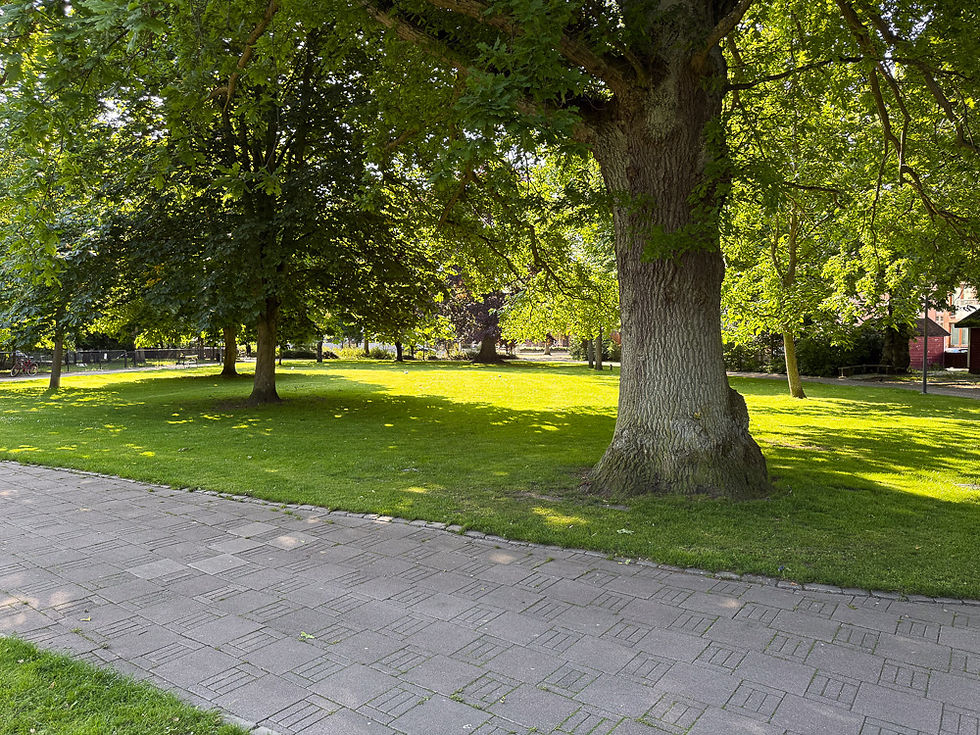
The City Park in Trelleborg was inaugurated in 1896. It forms the core of today's Trelleborg city and borders Stortorget on the west side and Badhuset on the east side. The area of the park has been reduced somewhat since it was established, partly due to surrounding buildings, but mainly because the Courthouse - which is now a museum - was built on the park's area. The park has a large music pavilion, two ponds, works of art, benches, paths, lawns and tall, old trees. In the northeast corner of Stortorget, right next to the park, there is a 53-meter-high water tower from 1912. On the first floor of the tower there is a café with outdoor seating overlooking the park and the square. The park has many exotic plants and appears beautiful and pleasant to be in.




Flaningen park
is a large green area a short distance west of the Foteviken Viking Museum. It has two ponds - one large and one smaller - surrounded by canals and walking paths. The ponds were created by digging out clay for nearby brick factories. They were covered with ice in the winter and were a gathering place for skaters until 1974 when the city got an indoor ice rink. After that, the ponds have had a water surface all year round. Today, the ponds are a good habitat for birds and a beautiful sight for walkers.


Dalabadet
is a large beach area with a long, shallow sandy beach, a bathing jetty, a campsite and a large parking lot. It is located about 3 km east of Trelleborg city center. The bathing jetty is 170 long and has benches and steps down to the water in several places with different depths in the water. There is also a separate ramp for wheelchairs.


Sweden's southernmost point
is located on a promontory called Smygehuk 14 km east of Trelleborg city center, about 16 minutes by car. There is a large parking lot for both cars and campers, shops, restaurants, artwork, an idyllic marina and an old lighthouse. Read more about Smygehuk here (https://en.turideer.com/post/smygehuk-sweden-s-southernmost-point-a-peaceful-sight-in-beautiful-skåne).


Nature reserves
Trelleborg kommune har mange små naturvernområder og fire viktige naturreservater:
Fårabackarna
Beddinge strandhede
Dalköpinge ängar
Maglarps sandtak
Fårabackarna naturreservat (nature reserve)
is located 23 km (26 minutes by car) east of Trelleborg city center. It is part of the original coastal plain that was preserved for posterity in 2008. The area was once used for grazing for sheep, and the northern part is still used for grazing, but most of it has been made available to visitors. There is a rich flora with over 100 different species. The area is 47 acres in size and is located directly adjacent to the beach. There are paths in the area that can be used. Right next to the nature reserve is Skateholms Camping. The reserve is connected to Beddinge Strandhede Nature Reserve to the west. There is a small parking lot right at the entrance to the nature reserve, but the parking at the campsite is close by.


Beddinge strandhede naturreservat
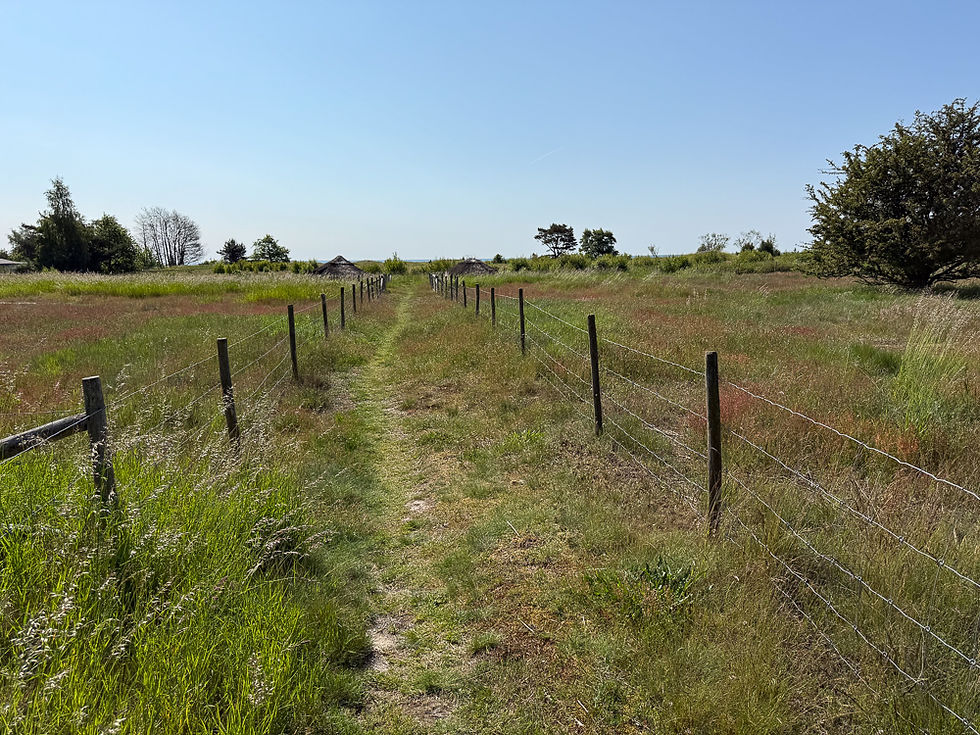
is connected to the Fårabackarna nature reserve to the west and the town of Beddinge to the east. It was set aside as a nature conservation area in 1996 and made a nature reserve in 1999 with the aim of preserving the important coastal heath in the area. Many protected plant species grow here. The common lark and the song lark nest on the plains, and the yellow-bellied woodpecker is also found. There is a path along the beach in parts of the nature reserve, and you can also walk over the fence to the pasture areas in some places. In the eastern part, horses and cows graze peacefully together. If you continue east along the beach, which is about 2 km long, you enter the Fårabackarna nature reserve. There is a 1.6 km route along the beach.


Dalköpinge ängar naturreservat
is located just east of Trelleborg city center next to Trelleborg Strand Camping. From the campsite it is only a 2-minute walk to the sandy beach and Dalköpinge meadows. The nature reserve was established in 1975. It is 30 acres, located along the beach on the Baltic Sea and is bordered by the river Gislövsån to the east. The land in the area has probably never been plowed and cultivated, but has been used for grazing for many years. This means that the flora has adapted to this form of cultural landscape, and it has been decided that there will still be grazing to maintain the character of the meadow. The wetland is ecologically stable and is a habitat for a number of birds, insects, plants and animals.


Maglarp sandtag naturreservat (Maglarp Sand Pit Nature Reserve)
consists of a disused sand pit with surrounding meadows. The sand pit was in operation from the 1920s until the 1960s and 1970s. After that, the remaining part of the sand pit and an area of about 80 acres were preserved as a nature reserve. A 90-meter-long slope in the sand pit has been preserved where Sweden's largest colony of sand martins has been nesting for the past 60 years. In the 1960s, 200 breeding pairs were observed there. In recent years, the colony has become significantly smaller.

In the excavated part of the sand pit, there has been a depression in the terrain that has gradually become overgrown with forest. In the forest and the area near the sand pit, a microclimate has developed that is particularly favorable for insects and insectivorous birds such as sand martins and bee-eaters.


In 2023, 2024 and 2025, bee-eaters have nested in the sandbank, and it is the first time this bird species has nested in Sweden. In 2023, there was only one pair there, in 2024 there were two single birds and three breeding pairs that raised several young, but in 2025 there have only been three birds there, one pair and one single bird. It is hoped that there will eventually be a viable colony of bee-eaters there, but it depends on how many young they manage to raise and how good the supply of insects is.


Trelleborg golfbane (golf course)
is a typical links course located right on the beach of the Baltic Sea. It is completely flat, but has several water hazards and areas of tall grass that make it a demanding course. As with all links courses, there is a big difference in difficulty in calm weather compared to windy weather. The course has an inviting clubhouse with pro shop and a good restaurant. It also has a small, intimate hotel attached in a renovated, older farm building by the driving range (https://trelleborgsgk.se).

More excursions: www.turideer.com
Excursion of the week: Trelleborg municipality in Skåne in Sweden - what to do in Trelleborg
Suitable for: Everyone


Comments