


Hjerkinn at Dovrefjell - the shooting range that became a national park - the largest nature restoration in Norwegian history - hiking in the mountains

From 1923 to 2006, Hjerkinn was an important military training and shooting range. From 2006 to 2020, an extensive nature restoration was carried out, removing roads, structures, and waste from decades of shooting and bombing to return the nature to its original state. Today, the shooting range is part of the Dovrefjell-Sundalsfjella Nature Park, where you can go hiking in beautiful nature and listen to the sounds of nature.

When Hjerkinn firing range was established in 1923, it was intended to be a military training range where the Armed Forces could test diverse types of weapons. At first, cavalry shooting was practiced in a small area, but later the range was expanded several times to cover the needs of the infantry, artillery, cavalry, and air force. The air force tested bombs, rockets, and machine gun ammunition. The total area was 165 square kilometers.

In 1999, the Storting decided to close the firing range at Dovrefjell and move it to Rena. However, the transition to civilian status occurred gradually, and the last bomb was dropped by an F16 aircraft as late as 2008. However, most of the training range was closed in 2006, and then the painstaking work began to remove all traces of the shooting and try to restore nature to its original state.

The work took 14 years, and during this time nineteen thousand small and large duds - unexploded grenades and bombs - 550 tons of metal waste, 430 cubic meters of wood waste and 145 cubic meters of residual waste were removed. The work was carried out by the Norwegian Defence Construction Agency, but fifteen thousand soldiers participated in it. Unfortunately, it is not yet possible to guarantee one hundred percent that absolutely all hazardous material has been removed, and people are therefore asked to report to the authorities if they find metal objects in nature, and to avoid touching them in any way.

The roads and military facilities in the area had to be dug up and restored. For safety reasons, much of the work was done with remote-controlled excavators and dump trucks, which meant that it took longer than it otherwise would have. To restore the original vegetation, gravel and soil had to be used that were suitable for the type of vegetation that was there before. As far as possible, existing masses or masses that had previously been removed from the area were used. Forsvarsbygg used the Norwegian Institute for Nature Research (NINA) as an advisor and partner. To achieve the most natural transition possible, clumps of plants and grass were transplanted from the roadsides into the restored areas. These will eventually spread and cover the entire area, but due to the short summer and harsh climate, it will take many years before nature has managed to reclaim what was once stolen from it. Therefore, it is still possible to see traces of roads and facilities. Twenty-five thousand willow plants were also planted in the area.

In 2018, the Storting decided to protect the area where the Hjerkinn shooting range had been located and incorporate it into the Dovrefjell-Sundalsfjella National Park. The goal is to create a larger, intact high mountain ecosystem where wild reindeer, arctic foxes, musk oxen, wolverines, golden eagles, and ravens can live. Protecting the wild reindeer population is an important objective for the protection of Dovrefjell as this is a species Norway has a responsibility to preserve.


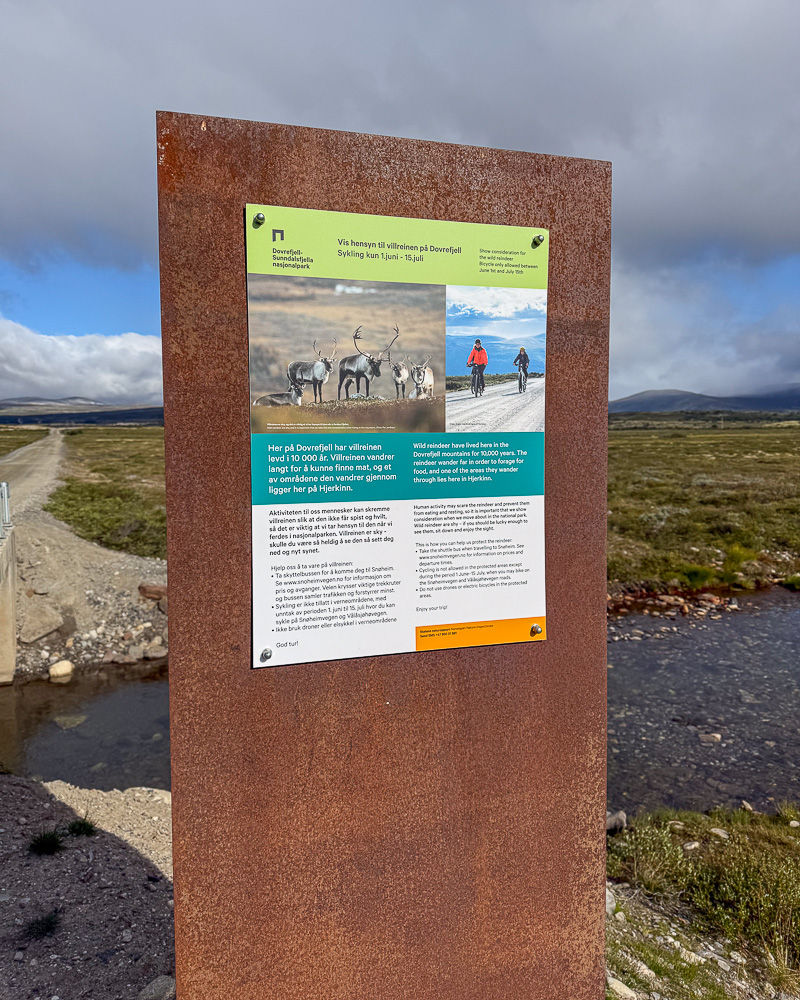
You are welcome to visit Dovrefjell-Sundalsfjella National Park. Because both nature and wildlife are vulnerable in this high mountain area, there are strict rules for traveling there. It is not allowed to cycle with either a regular bicycle or an electric bicycle. It is not allowed to use a drone. Dogs must be on a leash from April 1 to October 31. It is not allowed to move closer than 1 km from wild reindeer, and it is forbidden to follow them. It is also not allowed to move closer than three hundred meters from arctic foxes. It is not forbidden to approach musk deer, but a safety limit of two hundred meters has been set that you should follow. Musk deer can be dangerous if you get too close.


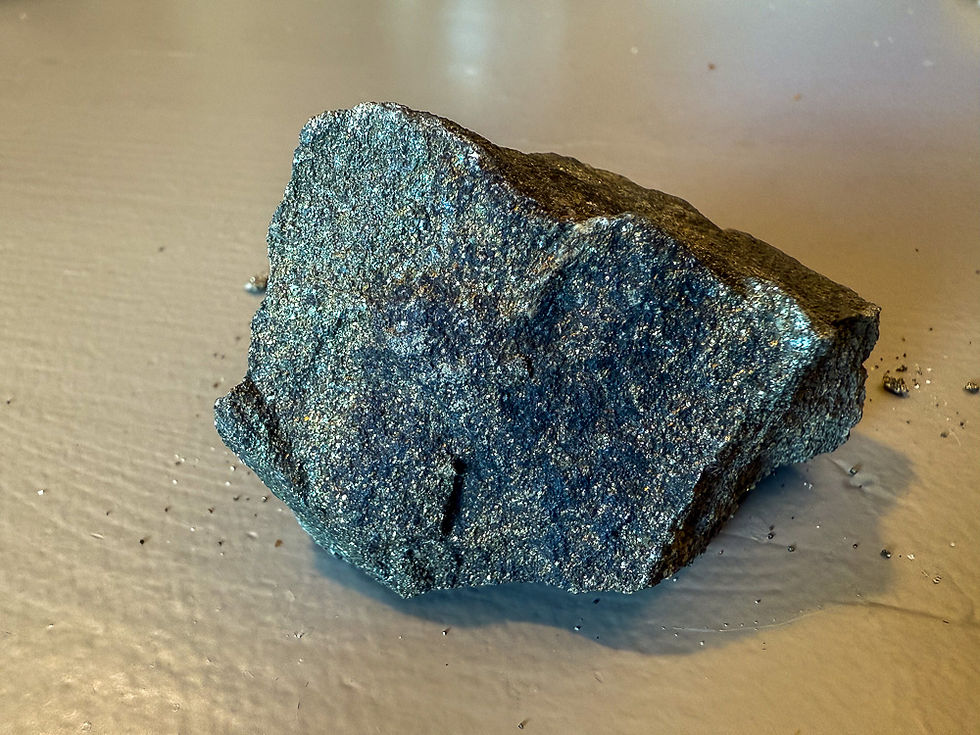
In Tverrfjellet just north of Hjerkinn station there was a large deposit of copper, zinc, and sulphur. Much of this mountain has been hollowed out after Folldal Verk operated mining there from 1964 to 1993. However, 990 kg of gold and 125 tonnes of silver were also extracted from these mines. As a curiosity, it can be mentioned that in the 1.6 km long gravel road that runs from Hjerkinn station up to the entrance to the Hjerkinn shooting range, massive quantities of crushed ore containing up to 3 percent gold were laid out. This was too low a gold deposit to be economically profitable to extract, and therefore it was used as the foundation for the road. If you walk this gravel road, you can still find gravel and small stones with tiny grains of gold in it.
The area where the Hjerkinn shooting range was previously located was for eighty years a place where neither animals nor people could move safely, and where people for miles around were bothered by noise from machines, bombs, and grenades. In 2020, the work on the nature restoration was completed. Now this part of Dovrefjell is an excellent hiking area for those who want to go hiking in the mountains. Here you can enjoy some of Norway's most beautiful nature and listen to nature's own sounds. If you are lucky, you may also see musk ox, wild reindeer, arctic fox, wolverine, falcon, and golden eagle.
More excursions: www.turideer.com - click on the topic button "Rewilding" to see articles about rewilding and nature restoration.
This week's excursion: Hike at Hjerkinn in Dovrefjell-Sundfjella National Park, the largest nature restoration in Norwegian history.
Suitable for: Everyone. If you follow the gravel road, you can use a wheelchair or stroller. The terrain is flat and comfortable to travel on even if you go off the road. There are several trails in the area.
How to get there: Enter "Viewpoint Snøhetta parking" to get directly to a parking lot at the entrance to the national park at Hjerkinn. Alternatively: Drive E6 from Dombås towards Trondheim. The parking lot at Hjerkinn is located on the left side of the road, approx. 35 km - 39 minutes' drive - from Dombås. There is a sign for Viewpoint Snøhetta.


Comments