top of page

Cima del Menajador - Parque Natural del Carrascal de la Fuente Roja in Alcoy - hiking in the mountains

  • Writer: Admin
    Admin
  • 12 hours ago
  • 6 min read

Ten kilometers from Alcoy in the north of the province of Alicante lies the Parque Natural del Carrascal de la Fuente Rojo nature reserve. There are several hiking trails in this area. One of the most popular goes to the top of El Menejador, which rises 1,356 meters above sea level. From there you can see the valley through which the Polop river flows, with the Sierra de Mariola mountain range on the other side and the city of Alcoy at the bottom of the valley to the east. You can also often see griffon vultures circling the mountain. The nature reserve has one of the best preserved oak forests in the Valencia region.

Kvinne på toppen av fjellet el Menejador ser ut over dalen med Alcoy på sletten

The forest you see in the photo above, taken from the summit of Menejador, is of the holm oak (Carrasca) type. It is a hardy oak species that tolerates the climate well. The oak forest is part of a 2,298-hectare nature reserve located between the municipalities of Alcoy and Ibi. The nature reserve was created in 1987. Most of the hike goes through this forest.


Gammelt kapell med hotellfløy Santuari de la Font Roja i Alcoy

The route starts at the Santuari de Font Roja, which is an old chapel with an attached hotel wing. There is a special reason why the chapel is located exactly where it is. In August 1653, a group of religious people found a white lily flower on the site where the building stands today. They thought it was so special that they wanted to dig it up and take it with them. But when they saw the root, they noticed that it resembled the Virgin Mary. This caused a great stir, and all the other religious people who saw it later agreed that it resembled her. When they discovered that the same was true of other flowers of the same type in the area, they gave it the name Madonna lily. They perceived this as a miracle and decided to build a chapel on the exact spot where the first plant was found. Font Roja and the chapel have been a destination for pilgrimages for hundreds of years.
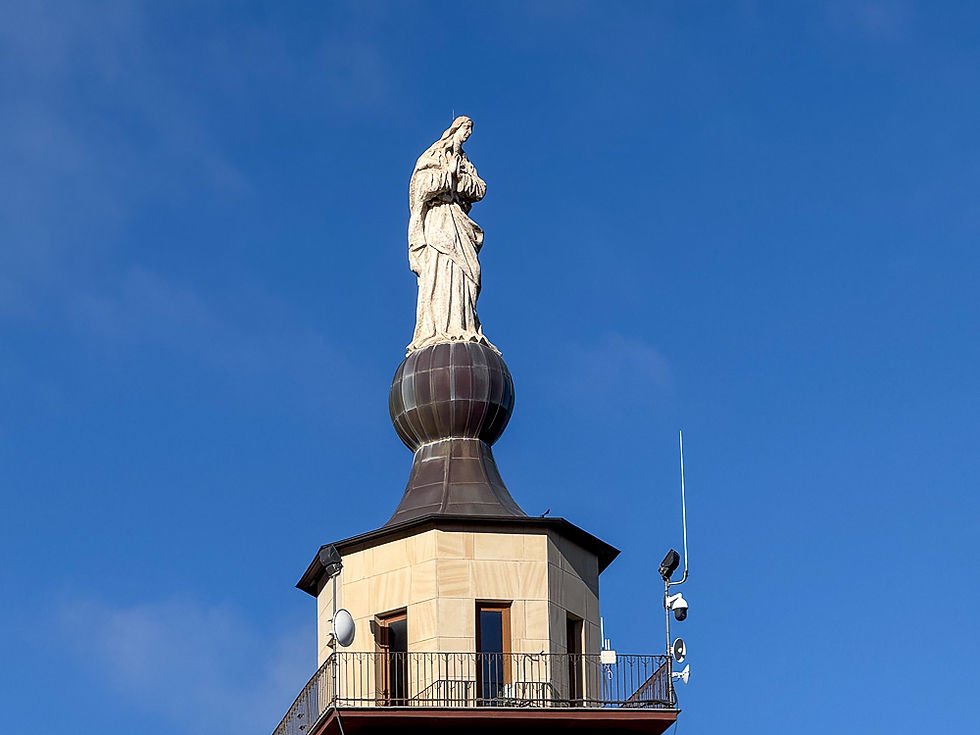

Statue på toppen av tårn på Santuari de la Font Roja

The chapel was consecrated on August 21, 1663. In 1720 it was renovated and a wing with accommodation was added, but due to decay, everything eventually had to be demolished, and in 1886 work began on creating a new chapel. The building we see today was consecrated on June 14, 1891, and a road was also made to it at that time. The hotel wing was built in the 1920s over the ruins of the old hotel and was long used as a recreation area for the wealthy in Alcoy and the surrounding area. Today the hotel is an information center for the nature reserve. Arrangements have been made for visitors to use the area. There is a large parking lot and a nice recreation area with stone benches and tables under shady trees nearby, and a separate building with toilets has been set up.
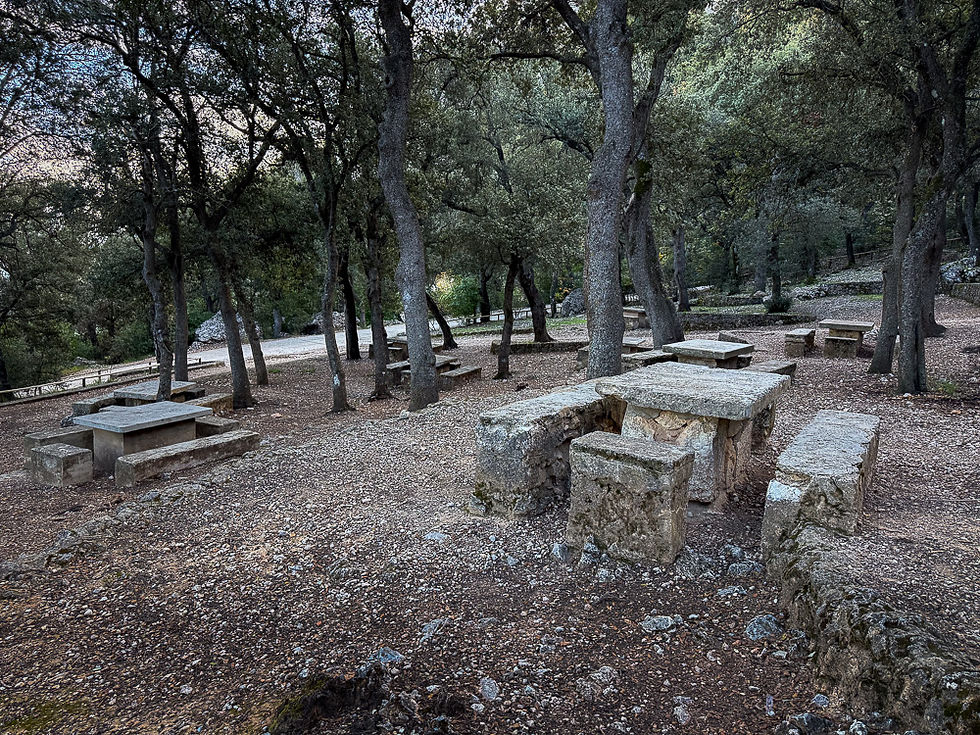

Rekreasjonsområde med benker og bord i stein i skyggen av tunge trekroner ved Santuari de la Font Roja i Alcoy

There are several signposted hiking trails from Santuari de Font Rojo. At the start, they all follow the same path. The route described in this post goes to the top of the el Menejador mountain. If you stand at the far end of the large terrace by the hotel wing and look up at the mountain behind, you can see a small yellow house on the top. That's where we're going, but to get there, you first have to walk a bit to the right along the side of the mountain before the slope allows you to go up to the top. There are two routes you can follow. The fastest, but also the steepest, goes on a path that is mostly made of steps. The most pleasant, but also the longest, goes on a driveable road with gravel and concrete pavement all the way to the top. There are three attractions along the way. One - cova Gelada - is only 300 meters away and is a small cave that holds up well to the winter cold. The second - Pla de la Mina - which is only 200 meters further, is a preserved lime kiln from the time when lime was extracted here. There is also a reconstructed kiln for making charcoal and a viewpoint. The third one you almost have to climb to the top to see, and it is one of the six preserved ice pits that were used to produce ice in the winter.


Skilt til el Menejador ved Font Roja i Alcoy
Signpost to the route that goes to the top of el Menejador and the route to Barranc de l´Infern

Grusvei under trekroner fra steineik ved Font Roja i Alcoy
Most of the route passes through one of the best preserved holm oak forests in the Valencian Community

Skilt til Cova Gelada ved Font Roja i Alcoy

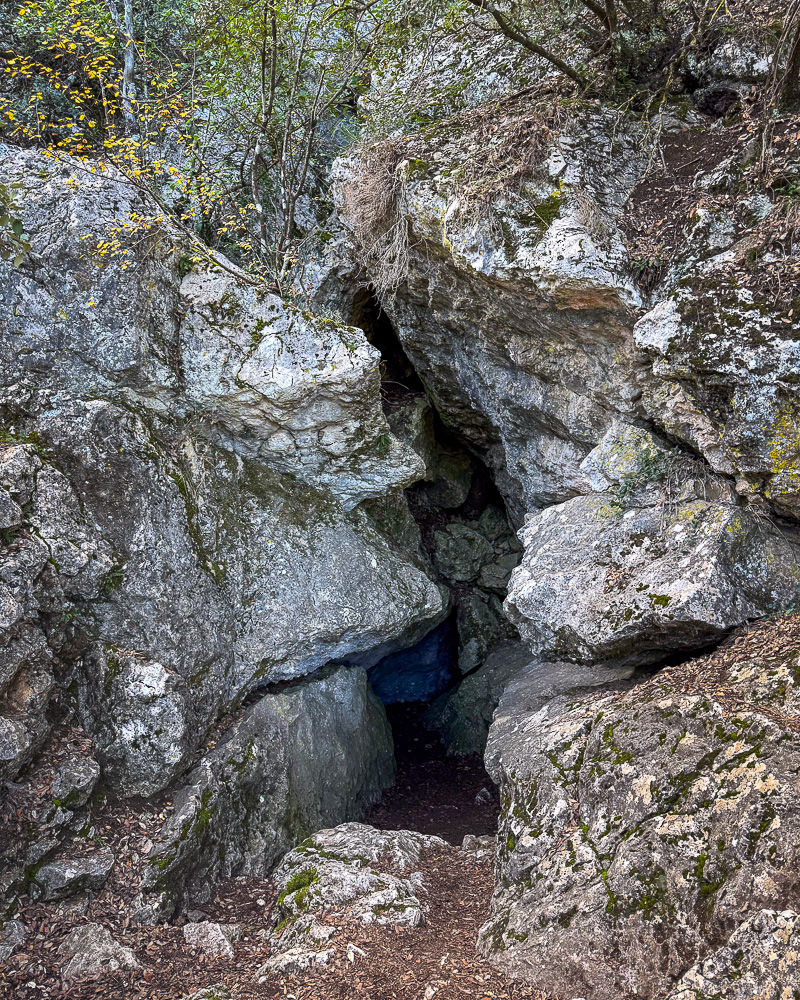
Åpning til hulen Cova Gelada ved Font Roja i Alcoy
After 300 meters you will come to a small cave that is cold even in summer.

Rekonstruksjon av produksjonsmetode for trekull ved Font Roja i Alcoy
Reconstructed kiln for producing charcoal. Wood was stacked as shown in the picture, covered with a layer of soil and leaves, and then allowed to char by slow combustion at a relatively low temperature. The charcoal was used for heating and wood stoves in Alcoy and the surrounding areas. Production continued until the beginning of the twentieth century.

Bevart kalkovn ved Font Roja i Alcoy
Pla de la Mina is one of the few preserved lime kilns in the area. Lime was produced in this way in this area until the beginning of the twentieth century.

Nærbilde av kalkovn ved Font Roja i Alcoy
Close-up of the lime kiln

Utsiktspunkt med tre ved Font Roja i Alcoy
The viewpoint from the small peak at Pla de la Mina
Trapp til snarvei til Cima del Menejador i Alcoy

Vei med betongdekke på vei til el Menejador i Alcoy
The road is driveable all the way to the top, but is closed to ordinary car traffic. It is mostly gravel, but is covered with concrete in the steepest sections.

Griusvei gjennom eikeskog i Parque Natural del Carrascal de la Fuente Roja de Alcoy

Informasjonsplakat ved utsiktspunkt i Parque Natural del Carrascal de la Fuente Roja de Alcoy
Along the route there are several viewpoints.

Skilt og trapp opp til snøgrop i Parque Natural del Carrascal de la Fuente Roja de Alcoy
As you approach the summit, you will see one of the six preserved ice pits from the time when ice was produced here in the winter. The ice was brought down in blocks to Alcoy and other nearby areas in the summer months. There it was used for cooling and preserving food and for the production of ice cream.
Nærbilde av snøgrop i Parque Natural del Carrascal de la Fuente Roja de Alcoy
The ice pit is an approximately 10-meter-deep stone silo. Here, snow was collected from the first snowfalls in November to the last in April. The snow was trampled hard and formed into cubes 1.5 meters wide, separated from each other by a thin layer of rice straw. During the winter, the snow was gradually transformed into ice. The ice pits were in use from the sixteenth to the beginning of the twentieth century. During this period, known as the Little Ice Age, the temperature in the area was much lower than it is today, and much more snow fell.

Grusvei på platået av el Menejador i Parque Natural del Carrascal de la Fuente Roja de Alcoy
The last part of the route goes on a plateau where you can see the yellow building on top of el Menejador.

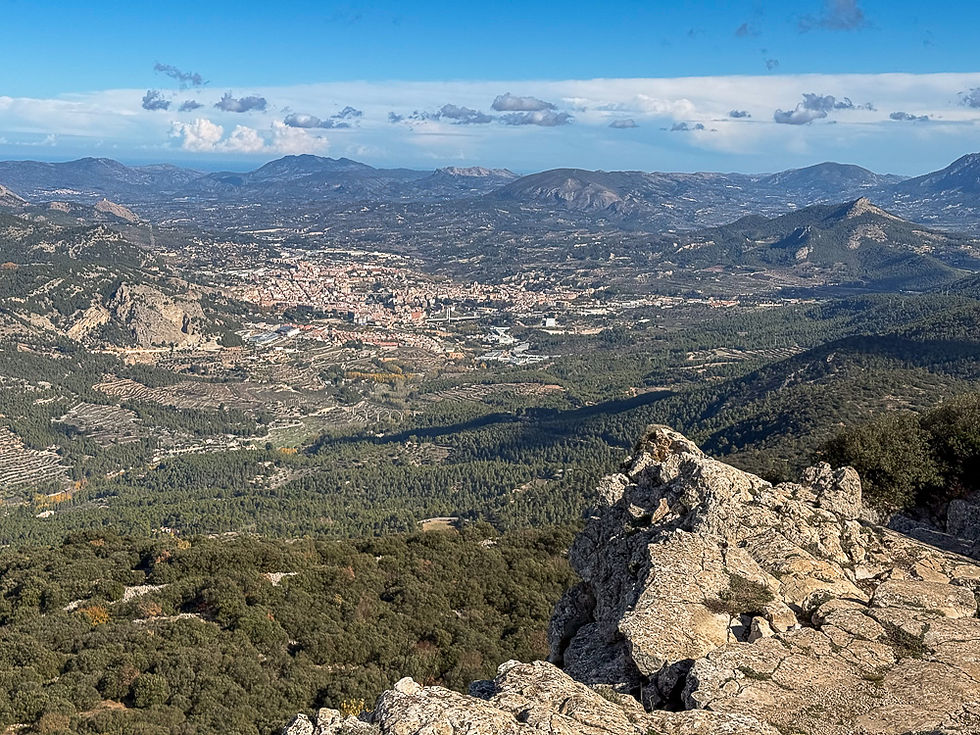
Utsikt til dal ved Parque Natural del Carrascal de la Fuente Roja de Alcoy
From the top of el Menejador you can see the wide valley that lies between el Menejador and Sierra Mariola

Skilt til el Menejador i Parque Natural del Carrascal de la Fuente Roja de Alcoy

Utsikt fra toppen av el Menejador i Parque Natural del Carrascal de la Fuente Roja de Alcoy
To the east you can see the city of Alcoy with one of the twenty bridges over the Serpis River which forms at the foot of Carrascal de la Fuente Roja and ends in the Mediterranean Sea at the coastal town of Gandia.
Gåsegribb i flukt over el Menejador i Parque Natural del Carrascal de la Fuente Roja de Alcoy
From the top of El Menejador you can see griffon vultures at relatively close range. They circle the mountain ranges in the area in search of food. The griffon vulture is a large bird. It weighs between 6 and 10 kg, has a body length of about 1 meter and a wingspan of about 2.5 meters. There is a breeding program for it in the mountainous areas on the opposite side of the valley (https://www.turideer.com/post/alcoy-gåsegribb-i-barranc-del-cint).

Nærbilde av gåsegribb i Parque Natural del Carrascal de la Fuente Roja de Alcoy
Close-up of a griffon vulture taken with a telephoto lens.

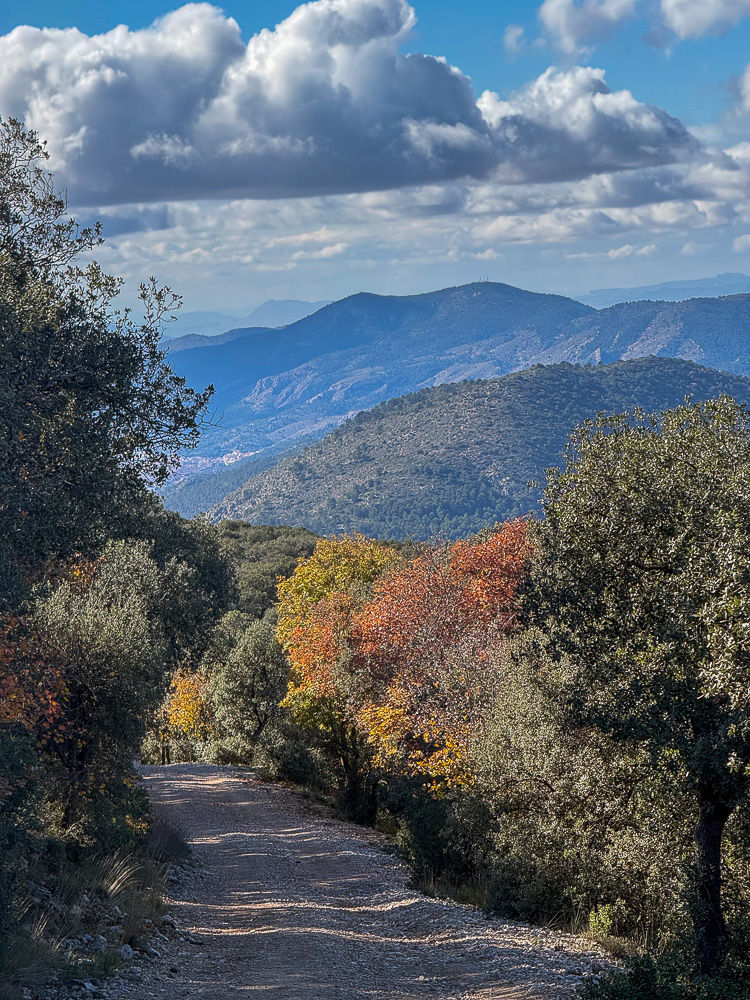
Grusvei gjennom eikeskog i Parque Natural del Carrascal de la Fuente Roja de Alcoy
On the way down you notice different parts of the view than on the way up.

Jorder i dalen nedenfor el Menejador i Parque Natural del Carrascal de la Fuente Roja de Alcoy

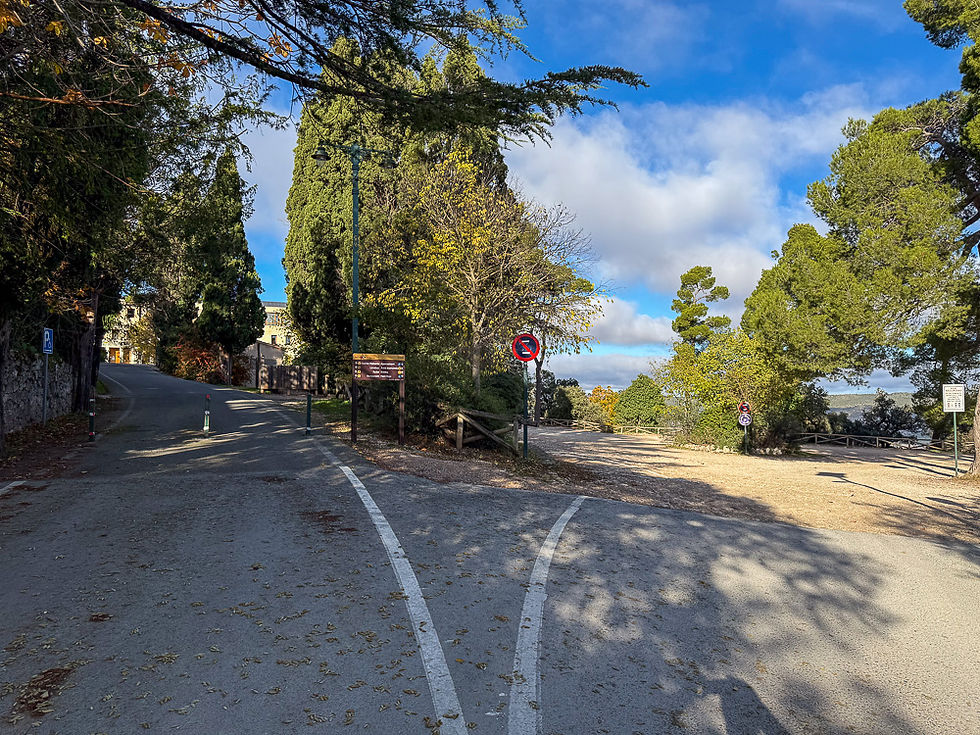
Innkjøring til parkeringsplass i Parque Natural del Carrascal de la Fuente Roja de Alcoy
The road to the Santuari de Font Roja ends in a parking lot in front of the old chapel and hotel which is now used as the information office for the nature reserve. The road on the left in the picture goes up to the top of el Menejador, but it is not accessible to ordinary car traffic.

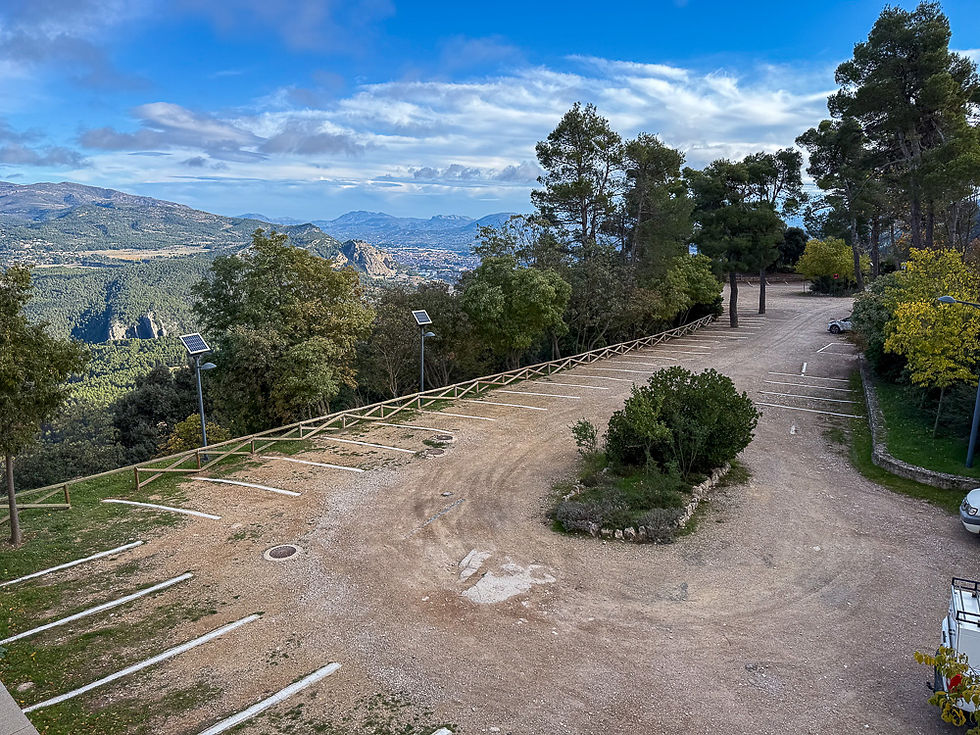
Parkeringsplass ved Santuari de Font Roja i Parque Natural del Carrascal de la Fuente Roja de Alcoy
The parking lot at Santuari de Font Rojo seen from the large terrace in front of the hotel wing.

More excursions: www.turideer.com


Excursion of the week: To Cima del Menajador - Parque Natural del Carrascal de la Fuente Roja in Alcoy - mountain hike


Suitable for: Anyone in normal physical condition. It is a long and relatively difficult climb that can be tiring, but there are no dangerous sections, and the road is driveable by car all the way to the top for personnel at the nature reserve.


Length: The hike is 6 km each way, a total of 12 km. It takes about 3-4 hours to walk with a few breaks along the way. The parking lot is located at 1000 meters above sea level, while the summit is at 1356 meters above sea level. You will therefore walk about 356 meters in altitude.


How to get there: Type "Santuari de la Font Roja" into Google Maps. This will take you to the parking lot by the old chapel where the hike starts. The routes are well signposted. Alternatively, you can take the A7 from Alicante towards Alcoy. When you get to Alcoy, take the exit towards Alcoy and then follow the N-340 at the first roundabout. After this, you can follow the signs for Font Roja or Santuari Font Roja until you reach the parking lot. There is a section of steep and narrow road with hairpin bends, but it is well paved the whole way.


Comments


© 2016 by Liv and Geir Stene-Larsen.

  • Facebook
  • Instagram
bottom of page